Tesla and His Unique Vision of Energy
Nikola Tesla did not think about energy in the way most scientists do today. While the classical physics of his time viewed energy through clearly defined systems and transmission via conductors, Tesla believed that energy is everywhere — in space, in nature, and in the very structure of the universe.
His vision was not only technical, but almost philosophical. He believed that humanity uses only a small fraction of the available energy and that there is a possibility of accessing unlimited sources if the right way of resonance with natural laws is discovered. For Tesla, energy was not something to be produced — but something to be discovered and brought into alignment.
This way of thinking opened the door to ideas that still provoke discussion today, including what is now often referred to as scalar energy.
What We Today Call Scalar Energy
The term “scalar” in physics has a clear meaning — it refers to quantities that have only magnitude, without direction, such as temperature or potential. However, “scalar energy” as it is used today in alternative circles goes a step further and describes a hypothetical form of energy that is not limited by classical electromagnetic laws.
In these interpretations, scalar energy is described as energy that does not travel through space in the usual way, but rather exists as a potential or a state of a field that can be activated. It is precisely this concept that attracts attention, as it implies the possibility of transmitting energy without loss and without classical media.
Although such a form of energy has not been confirmed in standard science, the idea itself resembles certain concepts explored by Tesla that went beyond the understanding of physics at the time.
Tesla’s Experiments That Open the Door to Alternative Interpretation
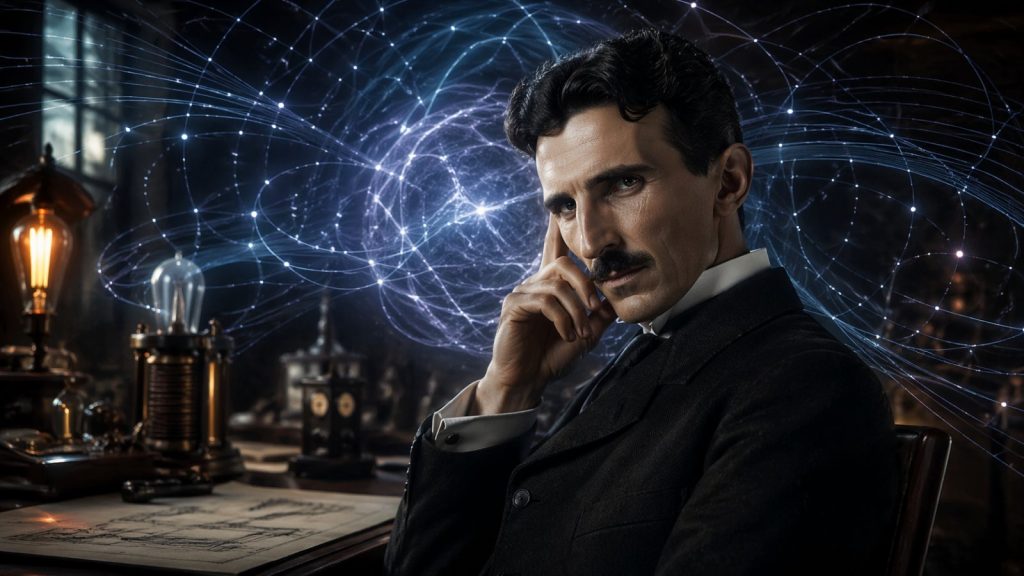
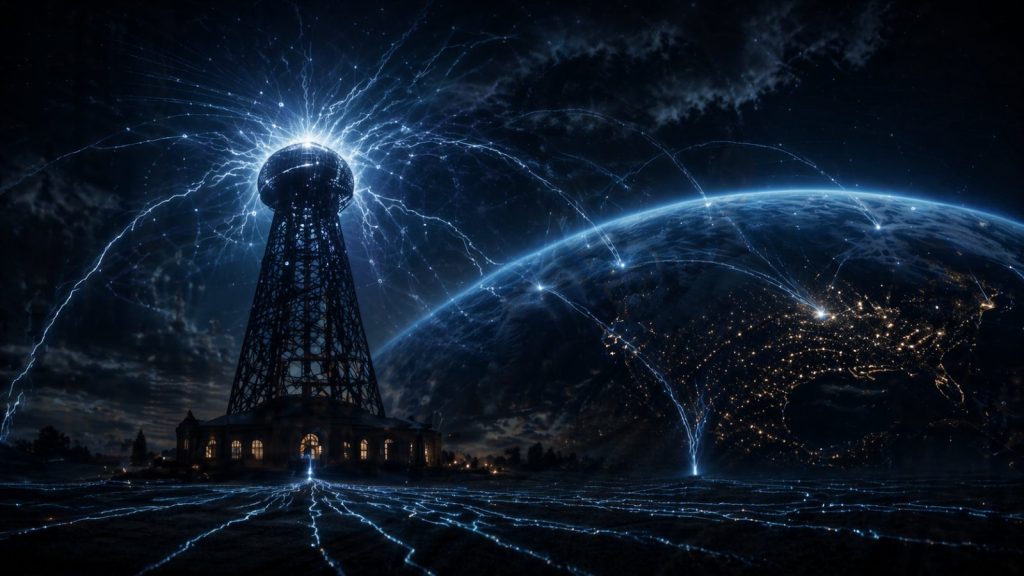
One of the most well-known examples of Tesla’s ambition was the Wardenclyffe Tower project. Its goal was not only wireless signal transmission, but the creation of a global system for transmitting energy without wires.
Tesla experimented with high voltage, frequencies, and the resonance of the Earth. He believed it was possible to use the planet itself as a conductor and create a system in which energy travels with minimal losses. Even today, such experiments appear almost unreal, as they do not fit neatly into standard models of energy distribution.
In addition, Tesla often spoke about energy that exists in the environment and that can be “captured” and used. Although he did not use terminology associated with scalar energy, his experiments leave room for interpretation that he was working with phenomena not entirely described by classical electromagnetism in the usual sense.
Scalar Interpretation of Tesla’s Work: A Perspective, Not a Term
Tesla never used the term “scalar energy.” However, his understanding of potential, fields, and resonance is often reinterpreted today through that concept.
When speaking of scalar aspects in relation to Tesla, it is essentially an attempt to explain his experiments using modern or alternative terminology. The idea that energy can exist as potential, rather than only as the movement of particles or waves, aligns with how Tesla viewed the world.
In that sense, scalar energy should not be seen as something Tesla “discovered,” but rather as a contemporary attempt to interpret his work through a different conceptual lens. That distinction marks the line between serious interpretation and exaggerated claims.
Can Energy Exist Without Loss?
One of the key ideas connecting Tesla with the concept of scalar energy is the possibility of transmitting energy without losses. Tesla believed it was possible to minimize losses through resonance and proper system alignment.
Modern physics acknowledges that every energy transfer involves some level of loss, whether due to resistance, dissipation, or other factors. However, technologies such as wireless charging and resonant systems demonstrate that these losses can be significantly reduced.
The question that remains open is whether there exists a method of energy transfer that completely bypasses classical limitations. It is precisely here that speculation about scalar concepts appears, along with the need for caution in distinguishing science from assumption.
Tesla as a Bridge Between the Known and the Unknown
Tesla continues to fascinate because he stands at the boundary between what we understand and what we are still trying to explain. His ideas were not limited by the technology of his time; they were often ahead of what science could practically achieve.
The concept of scalar energy can be viewed as an attempt to explain part of that vision — perhaps imprecise, perhaps unproven, but inspired by the real work and thinking of one of the greatest minds in history.
Ultimately, Tesla was not a mystic, but neither was he confined by convention. That is why his legacy continues to provoke new questions. And sometimes, those questions are more valuable than quick and simple answers.