Introduction: Why Ether and Tesla Are Still Connected Today
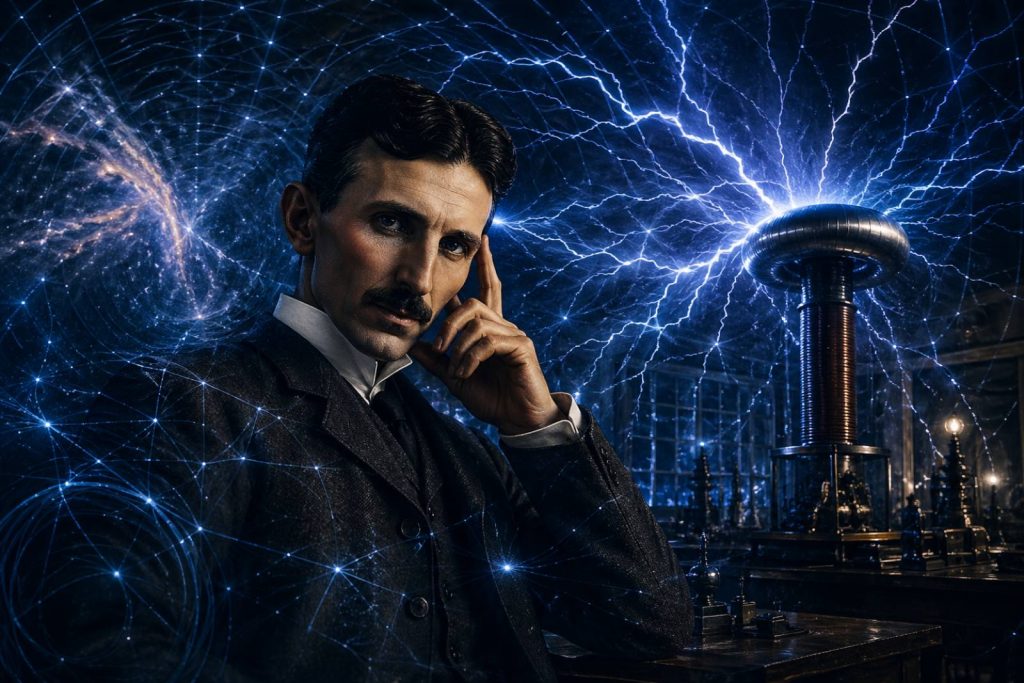
Nikola Tesla continues to inspire a level of fascination rarely achieved by any scientist. His ideas, inventions, and way of thinking are often discussed in the context of energy that goes beyond classical physics. One concept that is almost inevitably linked to Tesla is ether. Although this concept has been rejected by modern science, interest in it has not disappeared. On the contrary, it is reappearing in discussions about the energy of the universe, quantum physics, and spirituality. It is precisely this combination of scientific and mystical elements that makes the topic of ether especially intriguing.
What Is Ether? A Historical Concept and Its Role in Science
To understand why Tesla is associated with ether, it is first necessary to explain what ether actually is. In 19th-century classical physics, ether was imagined as an invisible medium that fills the entire universe. It was believed that light and electromagnetic waves travel through it, much like sound travels through air. This “luminiferous ether” was essential for the scientific understanding of natural laws at the time.
The idea of ether was so widely accepted that it was rarely questioned until the late 19th century. However, the problem was that ether was never directly detected. Despite numerous attempts, there was no clear evidence of its existence. This opened the door to major changes in physics that would soon follow.
Did Nikola Tesla Believe in Ether? His Ideas on Energy and Space
In this context, Nikola Tesla emerges as a thinker whose view of energy differed from most of his contemporaries. Tesla did not see energy purely through closed systems and classical models of transmission. His vision was broader and often approached philosophy.
He believed that energy is everywhere around us and that humanity uses only a small fraction of what is available in nature. He spoke about resonance, vibrations, and the possibility of accessing almost unlimited sources of energy. Because of this, many today claim that Tesla believed in ether or attempted to harness it.
However, it is important to be precise. Tesla did not leave behind a clear, systematic scientific model of ether that would meet modern standards of physics. Much of what is attributed to him today consists of interpretations, often exaggerated or taken out of context.
The Fall of Ether Theory: What the Michelson-Morley experiment Revealed and the Rise of Modern Physics
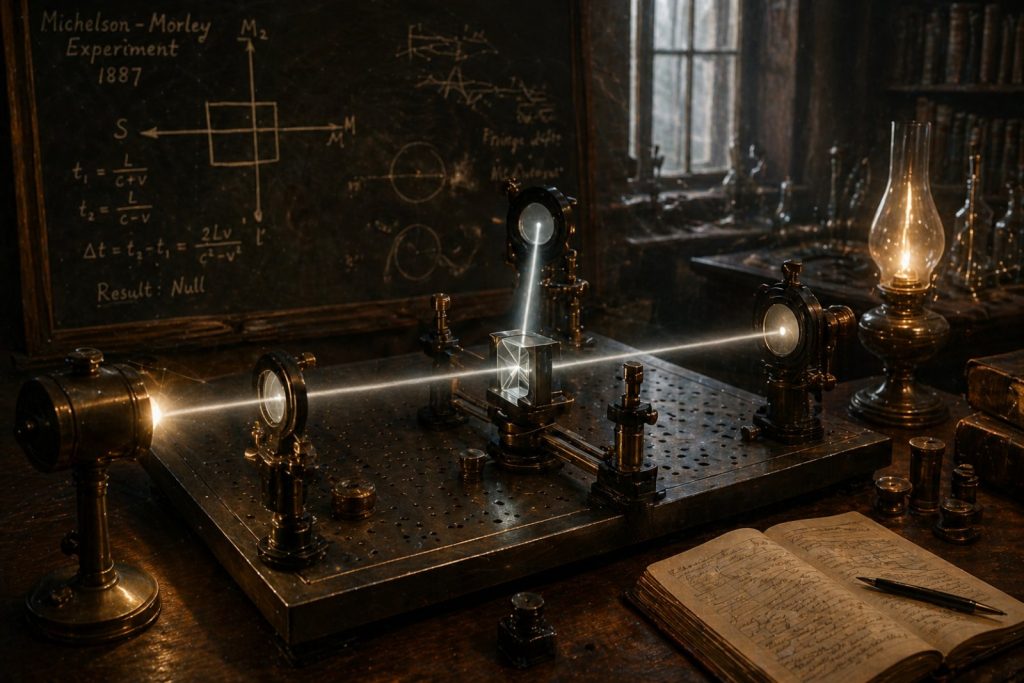
A turning point in the understanding of ether came with the Michelson-Morley experiment. The goal of this experiment was to detect Earth’s movement through ether. The results showed that such motion could not be measured, which seriously challenged the entire theory.
If ether existed, it was expected to have a measurable effect on the speed of light, but this was not confirmed. This result paved the way for a new way of thinking about space and energy, later developed through the Theory of Relativity.
Relativity eliminated the need for ether as a medium and introduced the concept of space and time as a unified structure. Energy and light no longer required a “carrier” in the classical sense.
Ether Today: Between Quantum Physics and Spiritual Interpretations
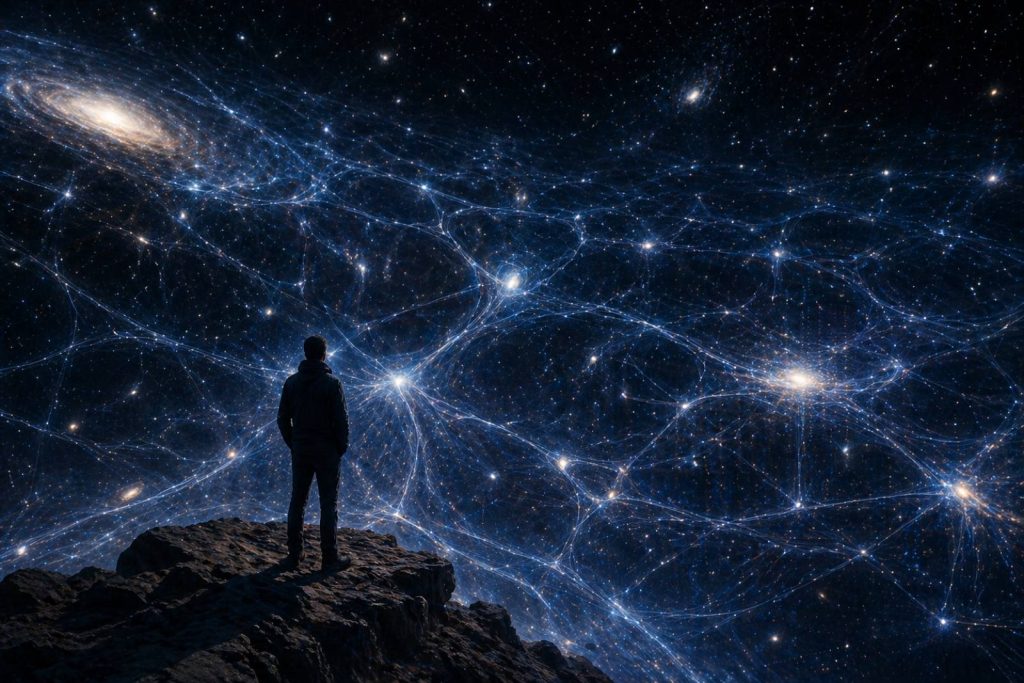
Despite this, the idea of ether has not completely disappeared. Today, it reappears in a different form. In modern physics, scientists speak of the quantum vacuum, a state that is not truly empty but contains energy and fluctuations at the subatomic level.
Although this is not the same as the 19th-century concept of ether, the similarity—namely, the idea that space is not empty—encourages new interpretations. Popular discussions often include terms like quantum energy or universal energy, which helps sustain interest in the topic.
At the same time, ether has gained popularity in spiritual circles, where it is often described as a universal energy connecting everything in the universe. In such interpretations, ether moves beyond science and into the realm of personal belief.
Was Tesla Ahead of His Time or Misinterpreted?
This leads to a key question. Tesla was undoubtedly a visionary who thought beyond the limits of his time. His work on electromagnetism, wireless energy transmission, and resonance demonstrates a deep understanding of natural laws.
However, many claims circulating online—such as the idea that Tesla discovered free energy or proved the existence of ether—lack solid scientific evidence. These claims often arise from the desire to elevate his legacy beyond what is already remarkable.
In reality, Tesla was an extraordinary engineer and innovator, but he did not provide proof of ether nor a method for extracting unlimited energy from space as is often suggested.
Conclusion: Ether as an Idea Connecting Science, Philosophy, and Imagination
Today, ether exists more as an idea than as a scientific fact. It represents an attempt to explain aspects of reality that we still do not fully understand. In that sense, its connection to Tesla is not accidental.
Tesla constantly sought deeper answers and believed that nature holds principles we have yet to uncover. Ether, in this context, remains a metaphor—a bridge between science, philosophy, and the human desire to understand the universe.
This is why the topic continues to attract attention. Not because it provides final answers, but because it raises questions that still do not have simple solutions.