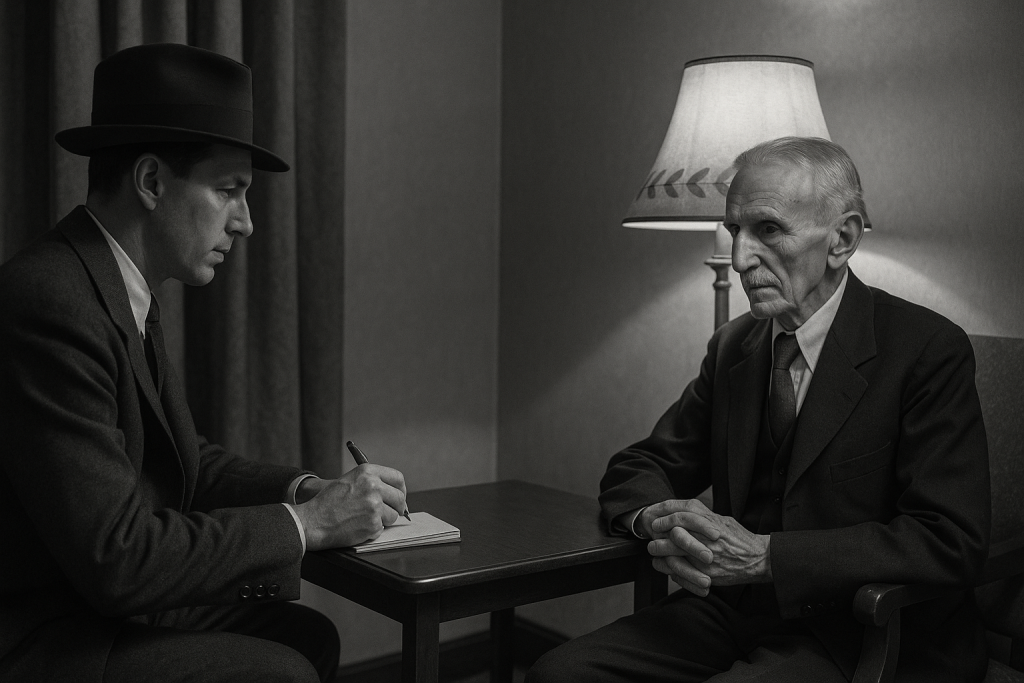
Journalist: Mr. Tesla, do you believe that life came into being by chance?
Tesla: We were created by a higher power. And this is not speculation, but the admission of a man whose name long ago became a myth.
Tesla: That is a question I asked myself even before I knew I would become a scientist. No, young man, nothing in this world is accidental. Everything is form. The entire universe is one equation, and behind it stands thought — not theory, not hypothesis, but thought, conscious and creative.
Journalist: Do you mean that reason stood behind the creation of man?
Tesla: I say that reason stood behind everything. If only you knew what I discovered after decades of experiments… But humanity was not ready.
Analysis: Here Tesla does not speak as a preacher, but as a man who sees cause, intention, and structure behind the order of the world. For him, “chance” is not an explanation, but a word people use to cover their own ignorance or their lack of a view of the whole. When he says that the universe is “one equation,” he does not mean mathematics alone, but the idea that reality has order and an inner logic. The “thought” he mentions can be understood as the principle that organizes the world, as a source of meaning, and not as mere human imagination. In this way, Tesla shifts the focus from the superficial question “how did it arise” to the deeper question “why does order exist.”
His statement that humanity “was not ready” reveals another theme as well: the difference between discovery and society’s ability to receive it. This is a common tension in the history of science: ideas arrive before their time, and people reject them because they shatter existing frameworks. Ultimately, this part of the interview invites the reader to stop seeking comfort in chance and instead develop responsibility toward their own thinking and actions. If the world has meaning, then man also has an obligation to live meaningfully, and not automatically.
I Tried to Build a Machine That Could Capture the Voice of the Ether
Tesla: You know, the ether is not just a medium. It is the memory of the universe. Thoughts, emotions, images, and directions are stored there. One day I heard something. It was not a voice in the ordinary sense. It was an impulse, a direction.
Tesla: When I was working on my research in Colorado Springs, I felt for the first time that space “breathes” — yes, breathes like a living organism. I sent out a wave and got an answer, not an echo. An answer as if someone on the other side of matter had understood that I had been noticed.
Tesla: My mistake was that I was trying to prove it with instruments. One only needs to listen, because everything has long been sounding, even your soul. No one disappears. We are all vibrations, and vibrations do not disappear.
Journalist: Forgive me, but you are a scientist. How can you speak of the soul, of God, as something that can be proven?
Tesla: I no longer believe — I know. I studied electricity, magnetism, vibrations. All of these are manifestations of the same thing. One day I realized that consciousness is vibration. It does not originate in the brain, but enters the brain. The brain is like a receiver, but the source is outside of us. We only think that we think; in reality, we are connected with the reality around us.
Journalist: Connected with what?
Tesla: With the field, with the source, that higher power which religions call God, and physicists the primordial field. I call it light.
Analysis: In this part, Tesla builds a bridge between physics and inner experience, trying to explain everything through one common language: the language of vibration, signal, and reception. “Ether” in his speech becomes a metaphor for the all-pervading background of reality, something like a space in which information is not lost but permanently present. When he speaks of “an answer, not an echo,” he describes the feeling that he is encountering not merely the natural return of a wave, but some kind of meaningful feedback signal.
In this way, he introduces the idea that the universe is not mute, but communicative, and that man is capable of registering that communication. The most radical claim is that the brain is a receiver and not the source of consciousness, by which Tesla overturns the usual image of man as a closed system. Important here is also his admission of “mistake”: instruments can measure, but they cannot always grasp the meaning of what is experienced.
Tesla does not reject science, but warns of its limits when it deals with phenomena that require a different approach. His story of light, field, and source suggests the unity of everything: electricity, magnetism, consciousness, and soul are not separate phenomena but different faces of the same reality. In the contemporary context, this can be read as a call for a broader picture: technology is powerful, but without understanding the inner dimension of man it becomes a blind force. Tesla compels the reader to ask whether they are even listening to the “signal” in their own life, or merely piling up evidence and data without inner clarity.
One Day I Tried to Measure the Power of Emotions
Tesla: One day I tried to measure the power of emotions: anger, joy, love. And do you know what I discovered? Every emotion has its own frequency. Love is the purest, the most harmonious. It is closest to what I call the source, the vibration of the universe. And fear is the worst: it repels, isolates, and blinds.
Journalist: You are saying that love brings us closer to that power of yours?
Tesla: I claim that. And more than that: it is its reflection within us. We were not created from clay, nor from an accidental molecule. We were shaped as an answer to the call of light.
Journalist: Then why do we suffer? Why do we die? Why do we not remember that connection?
Tesla: Because this is a test. The blind learn best to see. The lost value the path the most. We have been cast out from the source in order to learn to hear it again. It is not punishment, it is the path, and every life is a step.
Tesla: You have no idea how many times I stood on the edge of a discovery that could change everything. One day I created a resonance capable of affecting the cells of our body. They said: you cannot give people such power; they will not understand, they will be afraid.
Journalist: What then should we do?
Tesla: Wake up. Learn to listen again, not with your ears, but with your soul. Because every human being, even the most forgetful one, carries within himself a spark of that light. And if even one sees it, others will follow. And you are not here by chance. Perhaps you are one of those who must carry that spark further.
Analysis: Here Tesla treats emotions as real forces that shape man, not as passing “feelings” without weight. When he says that every emotion has a frequency, he is in fact saying that emotions have an effect: they bring the inner order of man into harmony or tear it apart. He describes love as the most harmonious because in it there is no disintegration, no inner war, but connection and meaning. He opposes fear to love because fear tightens, narrows perception, and makes man easily controlled.
Tesla then does not present suffering as meaninglessness, but as a process of learning: a path on which the connection with the source is re-established. In this way, he offers the reader an uncomfortable but powerful idea: forgetting is not a mistake, but part of maturation. A very important layer is also his story of “power” that must not be given to people because they are not ready, which opens the question of the ethics of knowledge and the danger of technology without maturity.
Here Tesla implicitly claims that the greatest danger is not energy, but the man who wields it from fear, greed, or unconsciousness. His advice to “wake up” is not a romantic phrase, but a demand for inner discipline: to learn to listen more deeply, to recognize one’s own impulses, and not to be a slave of the masses. The idea of a “spark” within every human being makes this part of the conversation practical: change does not begin from above, but in the individual who stops living automatically. Ultimately, Tesla is saying here that the greatest revolution is mental and moral, not technical.
Tesla Says: Nature Hears, It Responds
Tesla: Nature hears. It responds. We are called with it, we are called much more deeply than we think. I was not only conducting experiments with electricity; I was searching for the current of reality. The further I went, the clearer it became to me: matter is only human habituation, and the universe is consciousness.
Journalist: If that is true, if the soul is eternal, then why do people die in fear, in suffering, why is there so much pain?
Tesla: Because forgetting is part of the path. Imagine setting out on a journey, but before that erasing your memory: you do not know who you are, why you are here, or where you are going. And therein lies the meaning — that you remember, not with the brain, but with the soul. That you understand that you are not the body, that you are not here forever, that your pain is only a passing form in eternal light.
Tesla: Everything you touch, everything you feel, even your fears, are not your enemies. They are traces. Consciousness speaks to you, gives you signs. If you learn to read them, fear will disappear, because behind it light is always hidden.
Analysis: Here Tesla does not see nature as a cold mechanism, but as a living communication that constantly sends signals. When he says that he was “searching for the current of reality,” he is saying that he was interested not only in the technical phenomenon of electricity, but in the principle that stands behind all phenomena. The statement that matter is “habituation” suggests that what we experience as solid and final may be only the way our mind organizes experience. Within that framework, fear and pain become information, not enemies: traces that show where man has lost his connection with meaning.
Tesla offers a simple but difficult claim: people suffer because they have forgotten who they are and where they are going, so they experience every change as a threat. To “remember with the soul” means to return to an inner security that does not depend on outward circumstances. In this way, Tesla redirects the question from “why does pain exist” to “what is pain trying to say.” When a person learns to read the signs, he stops fleeing and begins to understand, and understanding reduces fear. In a practical sense, this is a call not to live life only through reactions, but through the interpretation of one’s own experiences.
Tesla implies that light is “behind fear,” that is, that fear is often only a doorway to greater clarity. This is demanding because it requires courage: not to suppress, but to observe and learn. His message is not that suffering disappears magically, but that man ceases to be its victim when he understands its role.
The First Sensations I Experienced
Tesla: I can never forget the first sensations I experienced when it dawned on me that I had noticed something that might have immeasurable possibilities for mankind. I felt as though I were present at the birth of new knowledge or the discovery of a great truth. My first observations positively terrified me, for there was something mysterious in them, not to say supernatural. At night I was alone in my laboratory. But at that time the idea had not yet occurred to me that those disturbances were intelligently controlled signals.
Tesla: The nature of my experiments ruled out the possibility that the changes were caused by astronomical disturbances, as some rashly claimed. Some time passed before the thought flashed into my mind that the phenomena I had observed might be intelligently controlled. Although at that time I could not decipher their meaning, it was impossible for me to think that they were entirely accidental. Within me there grew the feeling that I had heard one planet greeting another. There was purpose behind those electrical signals.
Analysis: Here Tesla describes the moment when scientific curiosity turns into existential shock: the feeling that he is touching something that goes beyond the usual frameworks of explanation. His fear is not fear of danger, but fear of the magnitude of the implications — as though he had become the witness of something that would change the way mankind understands itself. When he says that the observations “terrified” him, it shows how seriously he experiences the responsibility of discovery.
Tesla then also shows scientific discipline: he first rejects the easier explanations and does not accept hasty theories. Only after time does he allow himself the hypothesis of intelligent control, but even then he does not pretend certainty — he admits that he cannot decipher the meaning. The most important moment is his statement that it was “impossible” for him to think that everything was accidental, because it shows how analysis and intuition are joined within him.
The idea of a “greeting” suggests that he experiences the signals as communication, not as noise. In a broader sense, this is a story about the boundary of science: when a phenomenon appears that does not fit, man must expand his language and his question. In this part, Tesla shows how psychologically demanding true discovery is: it shatters certainty, demands patience, and the willingness to live a long time without a final answer. The message to the reader is that great advances do not come from quick conclusions, but from the ability to endure the unknown and keep working without false certainty.
As a Scientist I Try to Regulate the Machine I Call My Body
Tesla: As a scientist, I try to regulate the machine I call my body in accordance with the laws of the planet on which I live. Whatever scheme of life a man adopts, it must correspond to the physical machine created by the rotation of the globe.
Tesla: The physical law that divides the twenty-four hours into day and night also divides human life into two periods: one in which he lives and another in which he rests. This in itself seems to indicate the desirability of two meals a day in harmony with the rhythm of the world: one meal gives energy for the day’s work, the other supplies the body with material that will be restored during sleep.
Tesla: There is no conflict between religious ideas, religion, and the ideals of science. But science stands opposed to theological dogmas because it is based on facts. To me, the universe is simply a great machine that never came into being and will never end.
Tesla: The human being is no exception to the order of nature. Man is like the universe — a machine. Nothing enters our mind and determines our actions that is not directly or indirectly the result of stimuli striking our senses from the outside.
Tesla: What we call the “soul” or spirit is nothing more than the sum of the functions of the body. We are only waves in time and space that change without ceasing, and the illusion of individuality disappears in the merging of the next phases of existence.
Analysis: Here Tesla speaks in an intensely rational and almost cold manner, as if he wants to strip man down to the laws of rhythm, stimulus, and mechanics. When he calls the body a machine, he does not diminish man, but demands discipline: a machine works well only if it respects the conditions of its operation. His connection between day and night and rest shows that Tesla does not see health as a moral subject, but as a physical reality: the rhythm of the planet becomes the rhythm of the body.
The idea of two meals a day is not only a diet, but an attempt to align life with natural cycles, which is once again current today in discussions about metabolism, sleep, and stress. Tesla then enters the theme of the relationship between science and religion: he does not attack faith as a search for meaning, but dogma as the prohibition of questioning. For him, the key difference lies in method: science seeks verification, and dogma seeks obedience. When he says that the universe is a machine without beginning and without end, he wants to say that reality is not a “project” with edges, but a continuous process.
The most provocative part is the claim that the “soul” is nothing more than a function of the body, because by that Tesla insists that man can be understood without mysticism. But the paradox is that even in this strict picture he leaves room for depth: if we are waves that change, then we are part of a greater flow, not an isolated entity. His message is practical: man is not free if he does not understand his own mechanisms, because stimuli will guide him instead. Freedom, in Tesla’s sense, begins when you govern your rhythm, habits, and attention, instead of letting the environment program you. Ultimately, this is a call to self-regulation: not romance, but precise self-management in harmony with nature.