Tesla Did Not Play by the Rules of the Existing Market
Most people, companies, and systems operate within rules that have already been established. The market exists, competition exists, profit models exist, and the main question becomes how to be slightly better, faster, cheaper, or more visible than others. Such a space can often be compared to a “red ocean” — a place where everyone fights for the same customers, the same resources, the same power, and the same profit.
Nikola Tesla was not a man of that kind of thinking. He did not try only to improve existing systems. He did not observe the world exclusively through what already existed, but through what could still come into existence. His vision was not to create a slightly better candle, but to open the age of electric lighting. He did not think only about using existing energy sources more efficiently, but about a completely different relationship between humanity and energy.
That is why Tesla, although he did not live in a time when the term Blue Ocean Strategy was used, can be seen as one of the most interesting examples of a man who thought in precisely that spirit. He was not looking for his place in the existing energy world. He was trying to imagine a new energy world.
That is where his uniqueness lies. Tesla was not only an inventor. He was a man who saw possibilities beyond the boundaries of the market, industry, and social thinking of his time.
What Does Blue Ocean Strategy Mean?
Blue Ocean Strategy, in a business sense, refers to the creation of new value space instead of constant fighting in an overcrowded market. In a red ocean, competition is strong, the market is saturated, the rules are already defined, and the battle is fought over a small part of the existing space. Companies exhaust one another, lower prices, copy each other, and try to survive in a struggle that often does not create truly new value.
A blue ocean represents something different. It is a space where the goal is not only to defeat the competition, but to make the competition less relevant. Instead of fighting in an old category, a new category is created. Instead of competing by old rules, new rules are established. Instead of asking “how can we be better than others,” the question becomes “how can we create something others have not even imagined yet?”
When this concept is applied to Tesla, it becomes clear why he is so interesting. Tesla did not think only about how to produce another device for an existing market. He thought about how to change the very foundation of civilization: the production, transmission, and use of energy.
For him, energy was not merely a commodity. It was the foundation of humanity’s development. Precisely because of that, his way of thinking goes beyond ordinary business strategy. Tesla created a blue ocean not only in a market sense, but also in a civilizational sense.
Tesla Against the Industrial Logic of His Time
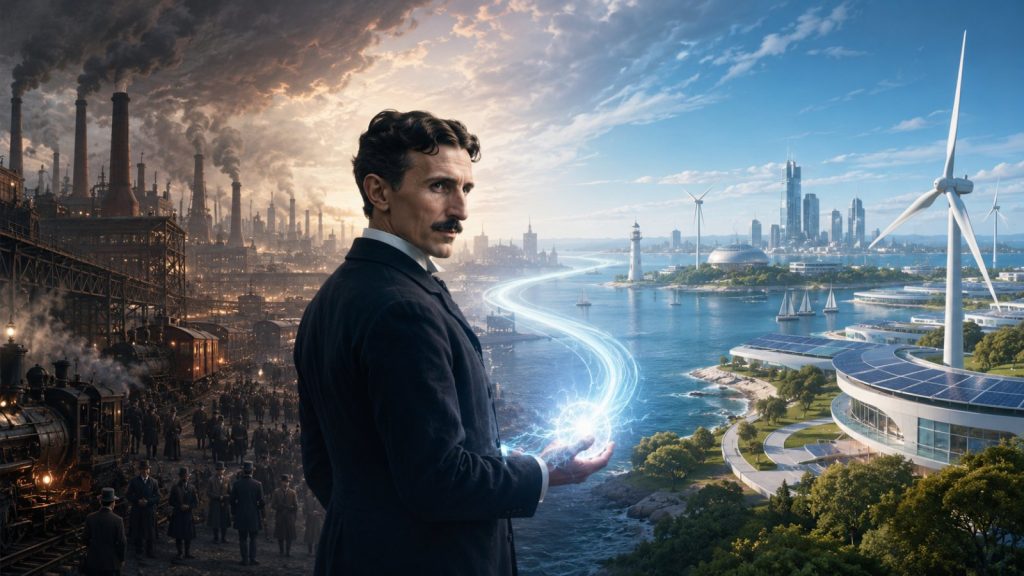
The time in which Tesla lived was a time of great industrial change. The world was rapidly becoming electrified, cities were growing, factories were expanding, and energy was becoming one of the most important resources of modern civilization. But at the same time, the logic of control was also developing. Whoever controls energy controls production. Whoever controls infrastructure controls the market. Whoever controls distribution controls access.
Tesla thought differently in such a world. His work on alternating current was not merely a technical solution. It became the foundation for the broader electrification of the world. His experiments with resonance, frequencies, and wireless energy transmission were not only scientific curiosity. They carried the idea that energy could be more accessible, more widely distributed, and less tied to limited systems of control.
Here we can see the conflict between two models. One model views energy as a commodity that must be produced, controlled, distributed, and charged for. The other model tries to understand energy as a natural force that should be aligned with the laws of nature and made useful to a wider circle of people.
Tesla did not easily fit into the logic of his time because he looked too far ahead. The market often demands what can bring a quick return on investment. Tesla thought about what could change the future. That is precisely why many of his ideas still seem unfinished, challenging, and almost outside the framework of ordinary business thinking.
Blue Ocean as a Space of Vision, Not Only Profit
Blue Ocean Strategy is most often viewed as a business tool. Companies use it to find new markets, create new demand, and avoid exhausting competition. But in Tesla’s case, the blue ocean can be viewed much more broadly.
Tesla did not create new value only to occupy a market niche. His ambition was much greater. He did not look only at what people currently wanted to buy, but at what humanity might need for decades or centuries to come. Such thinking does not create only a product. It creates a new possibility.
That is what separates ordinary innovation from great vision. Ordinary innovation can improve an existing system. Great vision can change the very question on which the system is based.
If the old question was: “How can energy be sold more efficiently?”, Tesla’s question could have been: “How can humanity be given a different, broader, and freer access to energy?”
That is the essence of the blue ocean in Tesla’s context. Not merely fighting for a better position within the old model, but opening a space in which the old model is no longer the only possibility.
That is why Tesla’s thinking naturally connects with today’s topics of green energy, ESG, decentralized systems, batteries, smart grids, and energy independence. All of these topics are trying to find a way out of the old energy model, which for too long was based on fossil fuels, centralized control, and the constant consumption of resources.

From Competition to the Creation of New Value
The true strength of Tesla’s work was not only in individual inventions. His strength was in opening the foundations for completely new systems. Alternating current was not merely a technical alternative. It enabled broader, more efficient, and more practical distribution of electrical energy. Electric motors, lighting, industry, communication systems, and modern cities all developed in a world that Tesla helped to open.
This is an important lesson for every strategy of the future. It is not always most important to be slightly better than the competition. Sometimes the most important thing is to create new value that the competition cannot easily copy because it is still thinking within old rules.
Tesla did not think about energy only as a product. He thought about the whole system: the source, transmission, frequency, resonance, accessibility, and the possibility of using natural laws in a different way.
This kind of approach is missing from many projects today. Many industries still try to repair the old model instead of daring to ask a new question. The energy sector often still revolves around control of sources, price, distribution, and political influence. But the real breakthrough may not happen only by making the existing system slightly cleaner. The real breakthrough may happen when we begin to see energy as a foundation of freedom, local resilience, and civilizational responsibility.
In that sense, Tesla is not only an example from the past. He is a reminder that the greatest innovations emerge when someone stops asking how to win in the old game and starts imagining an entirely new one.
Green Energy, ESG, and the Modern Blue Ocean
Today’s energy model increasingly shows signs of a red ocean. Fossil fuels, geopolitical conflicts, rising prices, pollution, climate pressures, and centralized control of resources create a system in which many fight over limited sources. In such a world, energy is not only a technical issue. It is a political, economic, social, and civilizational issue.
Green energy attempts to open a different space. The Sun, wind, water, geothermal energy, battery systems, smart grids, and local energy communities represent the possibility of no longer viewing energy exclusively through fossil fuels and centralized distribution.
ESG further expands that space because it introduces the question of responsibility. It is no longer enough for a project to be profitable. It becomes important what impact it has on the environment, the community, and the way it is governed. If a project is green only in advertising, and not in reality, then it does not represent a true blue ocean, but merely new packaging for the old model.
The real potential exists when technology, capital, and responsibility come together. Then green energy can become more than an industry. It can become a new space of value in which economic benefit, energy security, and reduced pressure on nature are created at the same time.
In that sense, the modern Blue Ocean in energy is not found only in a new product, but in a new relationship with energy. It is a space in which homes can produce part of their own energy, communities can develop local systems, investors can support sustainable projects, and individuals can gradually reduce their dependence on old models.
Why Tesla Still Remains a Symbol of Future Strategy
Tesla remains important today not only because he was an inventor, but because he represented a special way of looking at the world. His value is not only in patents and technical solutions, but in the ability to see possibility where others see limits.
While many looked at the existing market, Tesla looked at the laws of nature. While many thought about controlling energy, Tesla thought about its accessibility. While many tried to improve existing models, Tesla imagined new ones.
This kind of thinking is also necessary for today’s civilization. We cannot expect a different future if we constantly repair the same models that brought us to our current problems. Fossil fuels, excessive consumption, centralized control, short-term profit, and the exhaustion of nature cannot be the only foundations of the future.
Civilization needs new spaces. New energy models. New forms of responsibility. New relationships between technology, nature, and humanity.
Tesla is a symbol of precisely that kind of breakthrough. He reminds us that a true strategy for the future does not begin only with market analysis, but with the ability to imagine a world that does not yet exist.
Civilization Needs More Blue Oceans
Today’s civilization does not need only more technology. It needs more courage to step out of old patterns. It is not enough only to produce faster, consume more, and optimize existing systems. We need to ask what kind of world we are building and whom that world actually serves.
The red ocean of the past can be seen in the struggle for fossil fuels, in pollution, in the exhaustion of nature, in centralized control of energy, and in short-term profit that often does not take long-term consequences into account.
The blue ocean of the future could be a space in which energy becomes cleaner, more accessible, more decentralized, and more aligned with nature. This is not only a technical change. It is a change in civilizational direction.
Nikola Tesla sensed such a direction long before today’s debates about green energy, ESG, energy independence, and sustainable development. He did not look only at what existed, but at what could exist if humanity stopped thinking within the limits of the old system.
That is why Tesla and Blue Ocean Strategy together carry a powerful message: the future does not belong to those who adapt best to old rules, but to those who have the courage to create new ones.
If you are interested in the topic of free energy, Tesla’s inventions, resonant systems, and the possible practical applications of these ideas in the modern world, you can contact us through the email address listed in the contact section and footer of the website. Investors, researchers, enthusiasts, and all other people who want free and unrestricted energy are welcome to reach out at: tesladjordjevicsether3@gmail.com. This is a field that continues to raise many questions, inspire new discussions, and remind us that Tesla’s vision may not yet have been fully told.