
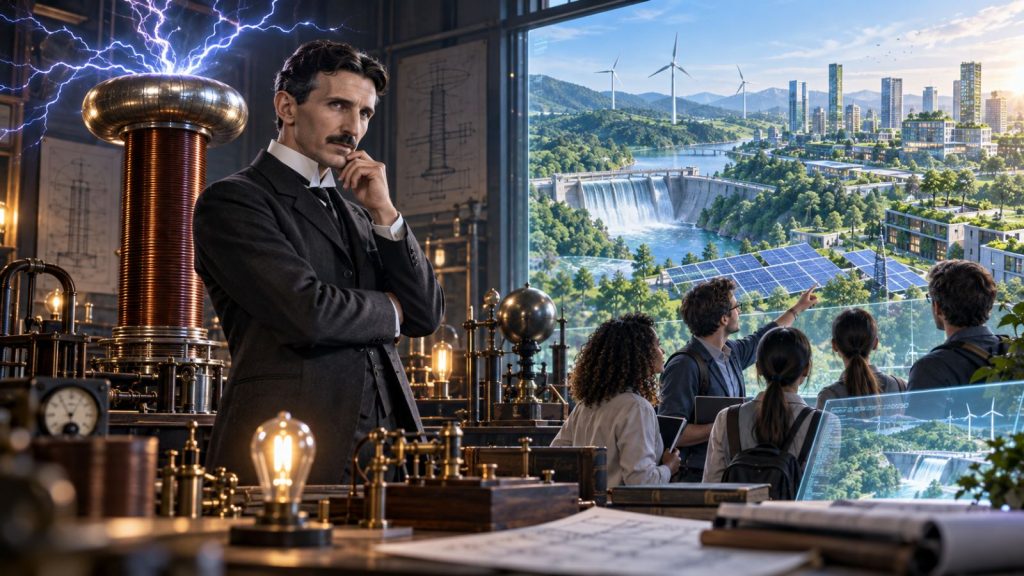
Introduction: The Green Transition Begins with People and Work
When we talk about ESG, the green energy transition, and sustainable development, we often first think of major technologies, solar panels, wind farms, investments, laws, international agreements, and new energy systems. However, behind every real change there are always people. Technology by itself cannot change the world if there are no people who understand it, use it, maintain it, and integrate it into everyday work.
That is why the green transition does not begin only in power plants, large companies, or national strategies. It also begins in the workplace, in organizations, offices, factories, schools, agriculture, construction, marketing, logistics, and human resources. Every job, regardless of sector, can have its own green dimension today.
If employees do not know how to reduce waste, save energy, use resources more efficiently, recognize environmental risks, apply green standards, and think sustainably, then an organization cannot become truly sustainable either. ESG must not remain only a word in a business report. It must become part of the culture of work.
This is exactly why green skills in human resources are becoming increasingly important. They represent a set of knowledge, abilities, and attitudes that allow employees to contribute to environmental protection, sustainable development, and more responsible business through their everyday work.
A green future does not arise only from new technologies. It arises from people who know how to work in a new way.
What Are Green Skills and Why Are They Important?
Green skills can be defined as the knowledge, abilities, and competencies that enable employees to perform their tasks in a way that reduces negative environmental impact, increases efficiency, improves productivity, and contributes to sustainable development.
These are not skills needed only by environmentalists, engineers, or renewable energy experts. Today, they are needed by almost everyone. They are needed by managers who make decisions, workers who operate machines, administrators who manage documentation, marketing professionals who communicate brand values, logistics specialists who plan transportation, builders who design facilities, and farmers who cultivate land.
Green skills make it possible for sustainability to be seen not only as theory, but as practice. They help employees understand how their work affects energy consumption, waste volume, emissions, resources, costs, and the reputation of the organization.
Their importance is growing because the modern world is facing many environmental challenges. Climate change, loss of biodiversity, air, water, and soil pollution, resource scarcity, and excessive consumption are no longer problems that can be postponed to the future. They are already shaping the economy, health, business, and quality of life.
Organizations that develop green skills can reduce their negative impact on the environment, increase competitiveness, improve reputation, and demonstrate real social responsibility. They do not wait for change to force them to adapt, but instead build capacity for the future themselves.
Green skills are therefore not an addition to modern business. They are becoming one of its foundations.
Environmental Challenges That Require New Knowledge
Old business models often emerged in a time when nature was seen as an endless source of raw materials. In that model, it was important to produce more, sell more, and grow faster, while environmental consequences often remained in the background.
Today, such an approach is no longer sustainable. Organizations are facing pressure from markets, laws, consumers, investors, and society to operate more responsibly. There is an increasing demand for proof that business operations do not harm the environment, that resources are used more wisely, and that planning is long-term.
Climate change brings instability, extreme weather events, and new business risks. Loss of biodiversity threatens the natural systems on which food, water, and health depend. Pollution reduces quality of life and increases social costs. Resource scarcity shows that consumption cannot grow without limits.
In such a world, organizations need people who understand the complexity of these problems. Good intentions alone are not enough. Concrete knowledge and abilities are needed. People need to know how to reduce energy consumption, how to manage waste properly, how to measure business impact, how to communicate sustainable values, and how to make decisions that do not look only at short-term profit.
Green skills help organizations move from a passive relationship with the environment to active impact management. They allow ESG to transform from a formal obligation into a real way of working.
Technical Green Skills
Technical green skills refer to concrete knowledge and abilities needed to perform jobs that directly affect environmental protection and sustainable development.
These can include knowledge in the areas of waste management, recycling, renewable energy sources, energy efficiency, sustainable construction, emissions measurement, water management, sustainable production, ecological design, and the use of green technologies.
An example of a technical green skill may be the ability to design a solar system, properly separate and process waste, optimize electricity consumption in a building, introduce LED lighting, use a smart device for consumption control, or develop a product that uses less material and creates less waste.
Technical skills are especially important in energy, construction, production, agriculture, logistics, and industry. However, their value increasingly extends beyond individual sectors. Almost every organization today needs at least a basic technical understanding of sustainability.
Without technical green skills, it is difficult to implement real change. A strategy may be good, but if people do not know how to apply it in practice, it remains only a document.
Generic Green Skills
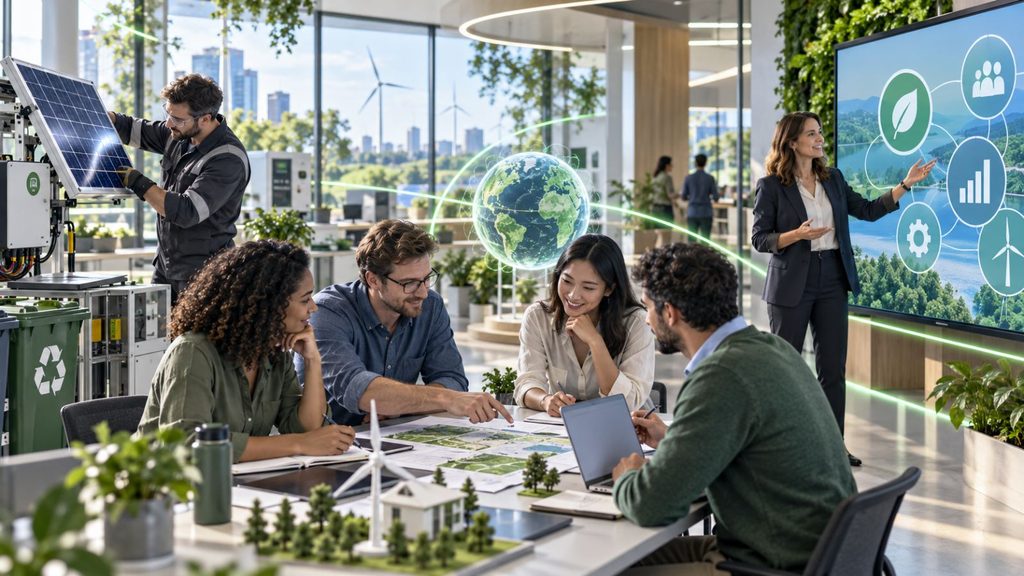
Generic green skills are not connected only to one job or one technology. They are applicable in different contexts and situations. These include critical thinking, problem-solving, teamwork, communication, creativity, adaptability, and the ability to see the broader picture.
These skills are important because sustainability is not always a simple technical issue. It often involves complex problems that require cooperation among different departments, different experts, and different interests.
For example, reducing waste in an organization does not depend only on the department that manages waste. It includes procurement, production, logistics, marketing, finance, and employee behavior. In order to solve the problem, people must communicate, understand causes, suggest solutions, and change habits together.
Critical thinking helps identify where an organization truly creates negative impact. Creativity helps find new solutions. Teamwork allows changes not to remain isolated. Communication helps people understand why something is changing and how they can participate.
Generic green skills are therefore important for all employees, regardless of their position. They create a sustainability mindset.
Strategic Green Skills
Strategic green skills refer to the ability to plan, organize, lead, and control activities related to sustainable development and environmental protection.
They include analysis, decision-making, change management, the development of sustainable business strategies, project management, risk management, monitoring results, and the ability to connect environmental goals with business goals.
These skills are especially important for managers, leaders, HR professionals, consultants, and decision-makers. An organization may have employees who want to work more responsibly, but if it does not have leadership that knows how to guide change, sustainability is difficult to develop systematically.
Strategic green skills allow an organization not only to react when a problem appears, but to plan a more sustainable direction in advance. They help set goals, determine priorities, secure resources, and monitor results.
In modern business, sustainability cannot be left to chance. It must be part of the strategy. And strategy can only be implemented by people who have the knowledge, responsibility, and ability to manage change.
Green Skills in Human Resources
Human resources have a key role in the development of green skills. If an organization wants to become sustainable, HR cannot remain on the sidelines. Human resources are precisely the function that hires, educates, develops, motivates, and guides people.
That is why green skills must become part of HR strategy. They can be included in job descriptions, candidate selection, onboarding, internal training, performance evaluation systems, career development, and reward programs.
When an organization hires new people, it can look not only for technical qualifications, but also for an understanding of sustainability. When it introduces new employees, it can familiarize them with the organization’s environmental rules, goals, and values. When evaluating performance, it can take into account contributions to waste reduction, more efficient work, and more responsible use of resources.
HR can also help create a green organizational culture. This means that sustainability must not be the task of only one department, but a shared value. Employees should know that their behavior has meaning and that small everyday actions, when added together, can have a major impact.
The green transition will not succeed if it remains only in management strategies. It must enter people’s habits. HR is one of the most important bridges between strategy and the real behavior of employees.
How Can Green Skills Be Measured and Recognized?
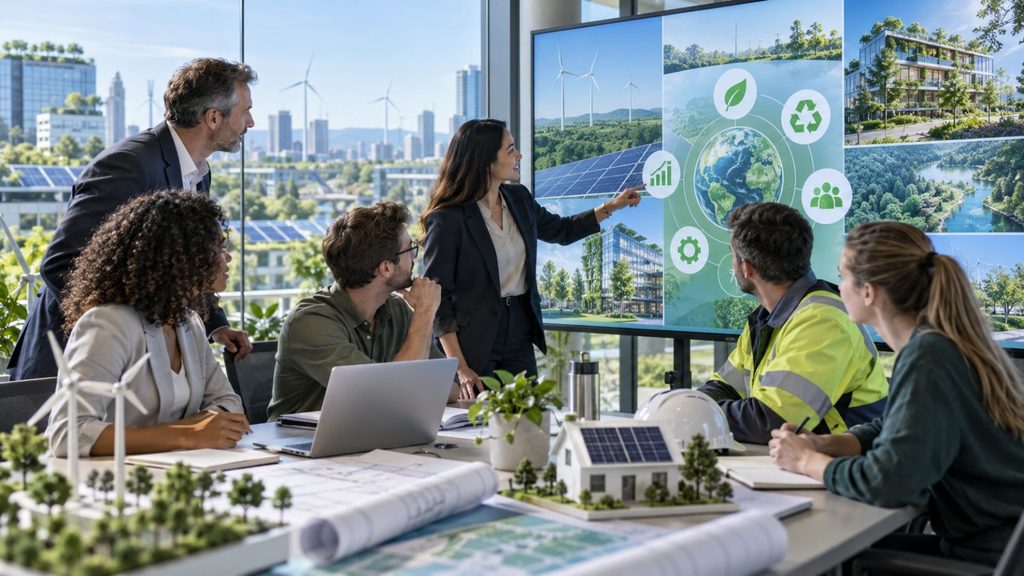
In order for green skills to be developed, they must be recognized and measured. What is not measured is difficult to improve systematically.
There are different ways to assess green skills. Organizations can use self-assessments, evaluations by supervisors, colleagues, or clients, knowledge tests, practical tasks, evidence portfolios, certificates, diplomas, and results of concrete projects.
Self-assessment can help employees reflect on their own knowledge and weaknesses. Evaluation by supervisors can show how skills appear in everyday work. Peer evaluation can reveal how much someone contributes to team-based solutions for green challenges. Tests and practical tasks can demonstrate concrete knowledge and the ability to apply it.
A portfolio of evidence can include projects in which an employee participated, implemented savings measures, examples of waste reduction, training results, or contributions to green initiatives. Certificates and diplomas can confirm formally acquired knowledge, but they should always be connected with practical results.
Measuring green skills is important for identifying training needs, recognizing and rewarding achievements, improving employability and employee mobility, monitoring progress, and assessing the impact on the well-being of the organization.
If an organization knows which skills it has and which it lacks, it can plan development more intelligently. Then the green transition becomes a manageable process, not a vague ambition.
Why Is It Important to Develop and Improve Green Skills?
Green skills are not knowledge that is acquired once and then remains sufficient for an entire working life. The world is changing quickly. Technologies are advancing, regulations are changing, market expectations are rising, and environmental challenges are becoming increasingly complex.
That is why the development of green skills is a process of continuous learning. It can take place formally and informally.
Formal learning includes schools, universities, professional education, certificates, seminars, and training programs. Informal learning can include workshops, internal training, mentoring, online courses, practical work, and learning through projects.
The development of green skills increases the quality of the workforce. Employees who understand sustainability adapt more easily to changes, recognize problems more effectively, and can actively participate in improving business operations.
Such development also increases motivation. People often want to feel that their work has a broader meaning. When they see that their behavior contributes to protecting nature, reducing consumption, and creating a better future, their work gains additional value.
For organizations, green skills mean greater resilience. An organization that has educated people adapts more easily to new rules, market demands, and changes in the economy. It can introduce innovations more quickly, reduce costs, and improve its reputation.
Green skills are therefore not a cost. They are an investment in the future.
Applying Green Skills in Practice
Green skills become real only when they are applied in practice. They must not remain only in training sessions, presentations, and strategies. Their true value is seen in the everyday work of the organization.
Application can begin with simple things: reducing paper consumption, properly separating waste, using energy-efficient devices, LED lighting, digitizing processes, more rational heating and cooling, more responsible procurement, and reducing unnecessary consumption.
At a higher level, organizations can introduce solar panels, smart devices, energy consumption monitoring systems, better water management, sustainable materials, green logistics, and circular business models.
Green skills can also be applied through standards and management systems such as ISO 14000, EMAS, and eco-labels. Such systems help organizations organize their processes, measure impact, and demonstrate seriousness in their relationship with the environment.
Green strategies also play an important role: green procurement, green marketing, green innovation, environmental responsibility, and business ethics. An organization that wants to be sustainable must think about the entire value chain, from suppliers to the end user.
The application of green skills shows that sustainability is not separate from business. It becomes the way work is done.
Obstacles to the Development of Green Skills
Although green skills are becoming increasingly important, their development is not always simple. There are many factors that hinder their implementation in organizations.
Some obstacles are market-related and economic. Organizations often fear costs, investments, and uncertainty. Short-term thinking can prevent investment in training, new technologies, and sustainable processes, even though such investments can pay off in the long term.
Other obstacles are social and cultural. Some people find it difficult to change habits. If they have worked in one way for years, change can create resistance. Sometimes sustainability is perceived as an additional burden rather than an opportunity for better work.
Organizational and managerial obstacles are especially important. If leadership does not support the green transition, employees can hardly implement major changes on their own. If there is no clear strategy, training, budget, and accountability, green skills remain fragmented.
That is why the development of green competencies requires cooperation between governments, companies, educational institutions, and employees. Governments can create supportive policies and regulations. Educational institutions can develop programs and new curricula. Companies can invest in people and processes. Employees can accept learning and actively participate in change.
The green transition is not the work of one sector. It is a shared task of society.
Clean Energy as the Key to Survival: From Vision to a Sustainable Future
Clean energy is one of the most important issues of a sustainable future. The International Day of Clean Energy is marked on January 26 around the world to raise awareness of the importance of transitioning to renewable energy sources, reducing pollution, and developing a more responsible relationship with natural resources.
This day reminds us that energy is not only a technical issue. It is a question of health, the environment, the economy, security, and future generations. The way we produce and use energy determines how much we pollute, how much we consume, and what kind of planet we leave behind.
Clean energy is connected with green skills because no energy system can function without people. Experts are needed who know how to design solar systems, maintain wind farms, develop smart grids, improve energy efficiency, manage data, and educate users.
Clean energy is therefore not only a question of equipment. It is a question of knowledge. If there are no people who know how to apply technology, even the best technology cannot achieve its full potential.
The transition to clean energy also requires organizations that are ready to change their processes. This includes saving energy, more responsible planning, the use of renewable sources, and understanding that energy efficiency is not only an environmental value, but also an economic one.
Nikola Tesla and the Symbolism of Clean Energy
Nikola Tesla holds a special place in every discussion about energy. His work on alternating current enabled more efficient transmission of electrical energy and laid the foundations for modern energy systems. In doing so, he opened the way to a world in which energy could be transmitted over long distances and used far more widely than before.
But Tesla is not important only because of his technical inventions. He is also important because of his vision. Tesla thought about energy as a force that could serve all humanity. His ideas about natural forces, wireless energy transmission, and accessible energy remain a symbol of scientific humanism.
Tesla imagined a world in which humanity could use natural forces, the energy of the Sun, wind, water, and the Earth, in a way that would serve development rather than destruction. Although today’s green transition is not the same as Tesla’s idea of free energy, it can be connected with his deeper message: energy should serve life.
In the era of climate change and energy transition, Tesla’s ideas gain new meaning. Solar panels, wind farms, hydropower plants, and energy efficiency reflect the need to use natural resources more responsibly, with less negative impact on ecosystems.
Tesla reminds us that science should not serve only profit and power. It should serve humanity, nature, and the future.
Tesla’s Concept of Wireless Energy Transmission and Free Energy
Tesla’s concept of wireless energy transmission and free energy for humanity remains one of the most inspiring symbols of scientific humanism. Regardless of how much individual parts of that vision are technically, historically, or scientifically debated today, its civilizational message remains powerful.
That message says that energy should not be only a means of control, billing, and domination. Energy should be the foundation of development, freedom, and a more dignified life.
Today, solar panels, wind farms, hydropower plants, and other renewable energy technologies are not the same as Tesla’s imagined free energy. But they carry part of the same idea: natural forces can be used in a way that reduces harm to the environment and increases benefit for humanity.
Countries investing in wind energy, solar energy, and other clean sources show that energy systems can change. Denmark is known for its strong development of wind energy, while investments in solar energy are increasing around the world. These processes are not perfect and do not solve all problems at once, but they show a direction toward a more sustainable future.
The International Day of Clean Energy serves as a reminder that sustainable development is achievable only with responsible policy, global cooperation, innovation, and people who have the knowledge needed for the green economy.
The transition to clean energy is not only a technical challenge. It is also a moral obligation toward future generations.
Green Competencies as the Foundation of the Green Economy
If we want to speak about a green economy, we must speak about green competencies. There is no sustainable economy without people who know how to build it.
Green competencies connect knowledge, skills, values, and responsibility. They enable employees to be not only task executors, but active participants in change. They help organizations reduce negative impact, increase efficiency, improve reputation, and better prepare for future challenges.
The development of green competencies is especially important in a world that is changing quickly. Labor markets are transforming, new professions are emerging, old professions are changing, and sustainability is becoming an increasingly important criterion of success.
Employees who possess green skills will be more prepared for the future. Organizations that develop them will be more competitive. Societies that invest in such knowledge will be more capable of transitioning to a green economy.
That is why green skills are not only a human resources topic. They are a question of the survival and development of civilization as a whole.
Conclusion: A Sustainable Future Is Built Through Knowledge, Work, and Responsibility
Green skills in human resources represent one of the key foundations of ESG, sustainable development, and the green energy transition. They make it possible for big ideas to become concrete actions, and for strategies to become everyday practice.
Organizations that want to be sustainable must invest in people. They must develop technical, generic, and strategic green skills. They must measure knowledge, recognize competencies, reward responsible behavior, and create a culture in which environmental protection is part of every workplace.
Clean energy, sustainable development, and the green economy will not happen by themselves. They require people who understand change, know how to use technology, and feel responsibility toward the future.
Nikola Tesla remains a symbol of a vision in which energy serves all humanity. Today’s green transition may still not be the realization of his deepest idea of free and accessible energy, but it can be a step toward a world in which technology and nature go hand in hand.
If we want a green economy, we need people with green knowledge, green skills, and green responsibility. Because a sustainable future does not arise only from technology, but from the awareness and work of people who know how to use that technology for the benefit of life.
If you are interested in the topic of free energy, Tesla’s inventions, resonant systems, ESG, green skills, clean energy, and the possible practical applications of these ideas in the modern world, you can contact us through the email address listed in the contact section and footer of the website. Investors, researchers, enthusiasts, and all other people who want free and unrestricted energy, more sustainable development, a green economy, and a more responsible relationship with the future are welcome to reach out at: tesladjordjevicsether3@gmail.com. This is a field that continues to raise many questions, inspire new discussions, and remind us that the vision of a cleaner, freer, and more responsible civilization may not yet have been fully told.