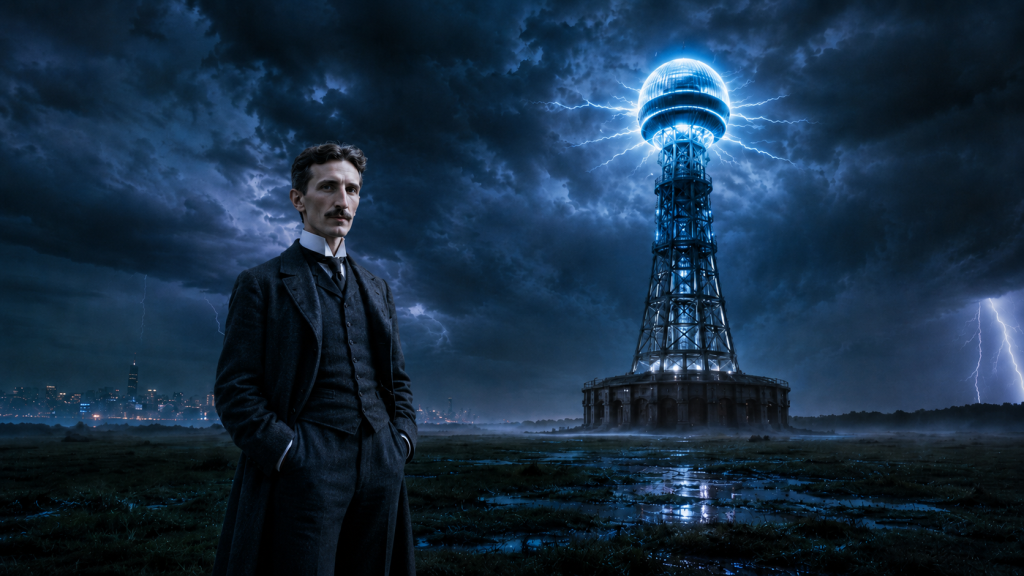
A Vision of Energy Available to All Humanity
Nikola Tesla was not only an inventor of electrical devices, motors, and systems that shaped the modern age. He was a man who saw electrical energy as the foundation of a new civilization. For him, electricity was not merely a technical discovery, an industrial product, or a commodity sold through wires and meters. Tesla saw energy as a universal force of nature, something that exists all around us and could, if properly understood, serve all of humanity.
That is precisely why his name is still often connected with the idea of free energy. This idea does not necessarily mean a simple claim that Tesla had a finished device capable of producing electricity “out of nothing.” It is far more interesting to view Tesla as a man who tried to think beyond the industrial, economic, and scientific limits of his time. He did not merely want to improve the existing system, but to find a way for energy to be transmitted more efficiently, more freely, and more accessibly.
When discussing Tesla and free energy, it is important to understand the broader context. The late 19th and early 20th centuries were a time of major technological change. The electrification of cities, the development of industry, and the struggle for control over energy systems created a new economic reality. In such a world, Tesla imagined something radically different: a planet connected by invisible flows of energy and information.
Wireless Energy Transmission and the Secret of Resonance
One of Tesla’s most important ideas was the possibility of wireless transmission of electrical energy. Today, wireless communication seems completely normal to us. We use radio waves, Wi-Fi, mobile networks, and satellite systems without thinking much about how revolutionary that idea once was. Tesla, however, was thinking about such possibilities at a time when most people were only beginning to understand the basic use of electric current.
He was especially interested in resonance. In the simplest sense, resonance is a phenomenon in which one system can respond with increased intensity when stimulated by the right frequency. Tesla believed that nature was not chaotic, but deeply ordered. He believed that energy could be transmitted and amplified if the correct frequencies, rhythms, and relationships were used.
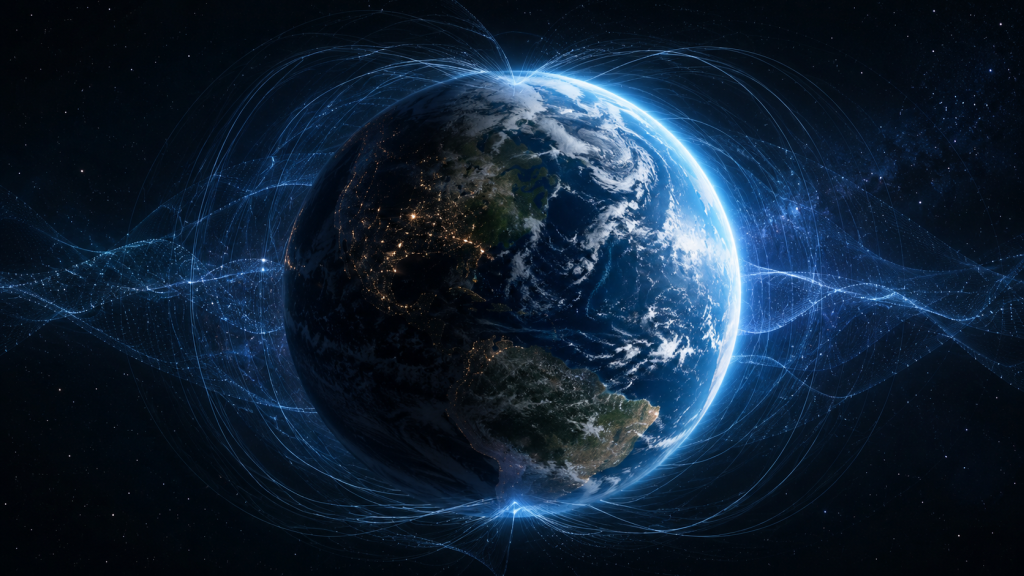
In this context, the idea is often mentioned that Tesla viewed Earth as a kind of resonant system. According to this interpretation, the planet is not merely a sphere of matter on which we live, but a vast natural conductor, a medium through which energetic impulses can be transmitted. This is where Tesla’s story begins to approach an area that still provokes debate today: where does official science end, and where do alternative interpretations of his experiments begin?
Supporters of the free energy idea believe that Tesla may have glimpsed a way to use the natural energy potentials of Earth, the atmosphere, and the electromagnetic field. Critics, on the other hand, point out that there is no solid proof that Tesla developed a fully functional system of unlimited energy. Yet what remains undeniable is that Tesla thought far ahead of his time and opened questions that continue to intrigue researchers, engineers, and enthusiasts even today.
Wardenclyffe Tower: The Project That Could Have Changed the World
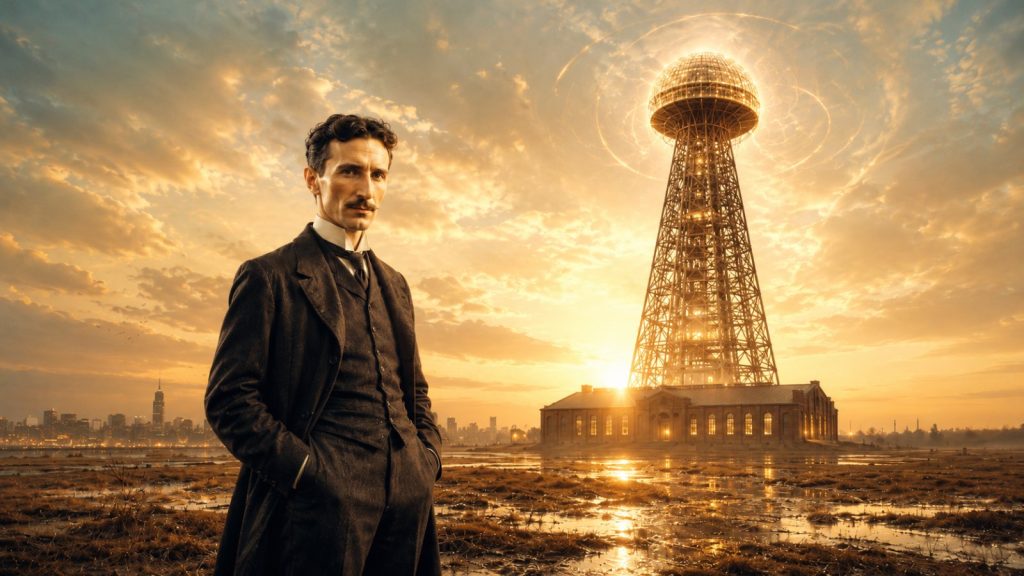
The most famous symbol of Tesla’s vision of wireless energy was Wardenclyffe Tower. This ambitious project on Long Island was intended to be much more than an ordinary tower. Tesla envisioned it as the center of a system for the global transmission of signals, communication, and, according to some interpretations, electrical energy.
Wardenclyffe Tower has almost mythical status today. For some, it was an unfinished communication project. For others, it is proof that Tesla was on the verge of creating a system that would enable energy transmission without conventional infrastructure. In any case, the tower represented an idea of the future that did not fit into the business model of its time.
If energy could be transmitted wirelessly and widely distributed, an uncomfortable question arises: how could it be charged for? How could a system be controlled if it did not depend on conventional cables, centralized power plants, and meters? This is exactly where one of the most famous theories connected to Tesla emerges — the idea that his work was stopped because it could have threatened existing interests.
Historically speaking, the project lost financial support. Investors were not convinced that Tesla’s vision could be commercialized in a way that would bring secure profit. That is a completely realistic explanation. At the same time, however, it is difficult to ignore the broader symbolism. Wardenclyffe did not fail merely as a construction project. With it, one possible version of the future also disappeared — a future in which energy might not have been organized exclusively through centralized systems of control.
Why the Idea of Free Energy Became a Threat to the Existing System
Energy has never been merely a technical issue. It has always been a question of power as well. Whoever controls energy controls industry, transportation, communication, food production, technology, and people’s everyday lives. That is why the idea of free energy is not only a scientific topic, but also a deeply social, economic, and political one.
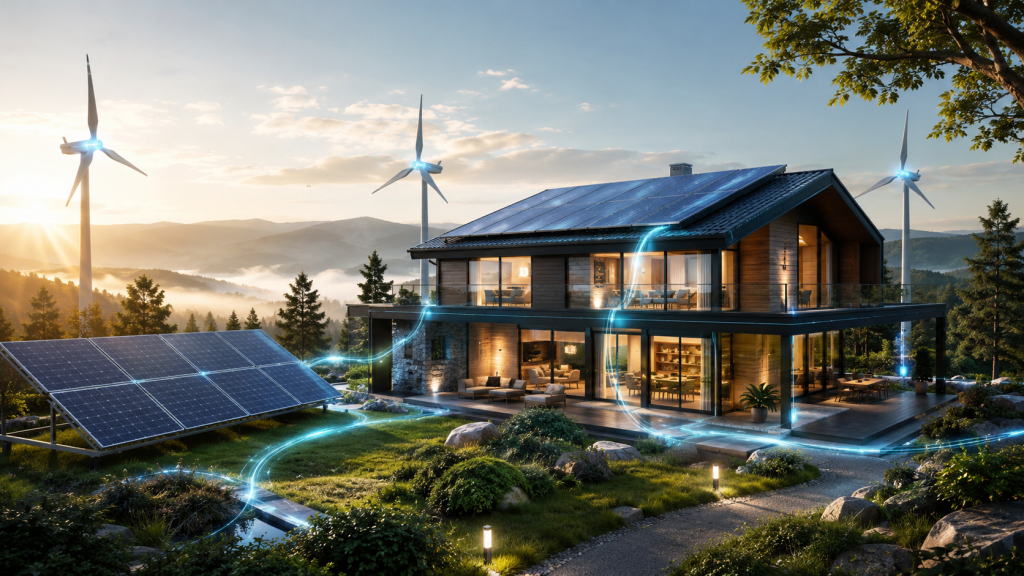
If a system appeared that enabled access to energy without major costs, without constant dependence on central suppliers, and without the conventional billing model, the consequences would be enormous. Such technology would change the way states, companies, and households function. Self-sustaining homes, independent energy systems, and local energy production would reduce people’s dependence on large networks.
That is precisely why many believe Tesla’s ideas were not merely “premature,” but potentially dangerous to the existing order. It is not necessary to claim that there was one hidden plan or a simple conspiracy. Reality is often more complex. It is enough to understand that technology which changes economic relationships always encounters resistance. If an idea threatens an existing profit model, it does not necessarily need to be banned. Sometimes it is enough to deny it funding, push it out of public interest, or portray it as unserious.
In that sense, Tesla became a symbol of an inventor who wanted more than his world was ready to accept. His vision was not limited to markets, patents, and industrial contracts. He spoke of humanity, nature, frequencies, and energy as something that goes beyond ordinary commercial logic. It is precisely this breadth that makes him so compelling even today.
Between Science, Myth, and Forbidden Knowledge
The topic of Tesla and free energy exists on the border between science, myth, and alternative interpretations of history. On the one hand, official science does not accept the idea of unlimited energy arising without a source, without cost, and without respecting basic physical laws. Energy cannot simply be created out of nothing. Every system must have a source, transmission, losses, and limitations.
On the other hand, it would be superficial to reduce Tesla’s ideas only to what has been technically confirmed today. The history of science is full of examples of ideas that were initially mocked, rejected, or considered impossible. Many great changes began as visions of individuals who did not think within the accepted frameworks of their time.
That is why it may be fairest to say that Tesla did not leave behind a simple answer, but a series of open questions. Is it possible that some of his concepts remained insufficiently explored? Is it possible that wireless energy transmission has greater potential than is commonly used today? Have we fully understood the relationship between frequency, resonance, Earth, and the atmosphere? And most importantly: was Tesla’s idea of “free energy” perhaps less literal and more civilizational — the idea of a world in which energy becomes more accessible, more fairly distributed, and less subject to control?
Precisely because of these questions, Tesla remains an inexhaustible topic. His work attracts not only scientists, but also people who feel that there is something deeply unbalanced in the modern world. We have advanced technologically, yet we are still dependent on systems that are often neither cheap, fair, nor sustainable. Tesla’s vision therefore lives on as a reminder that the future does not have to be merely a continuation of the existing model.
Possible Practical Applications of Free Energy Today
When speaking today about practical applications of free energy, one must be careful, but also open-minded. We should not casually promise miraculous devices, unlimited electricity, or technology that erases all costs. At the same time, we should not dismiss the fact that Tesla’s ideas continue to inspire research in the fields of wireless energy transmission, resonant systems, renewable sources, self-sustaining homes, and decentralized energy solutions.
There are already technologies today that, in a certain way, resemble parts of Tesla’s vision. Wireless device charging, energy transmission over short distances, solar panels, home batteries, microgrids, and systems of energy independence show that the world is gradually moving away from a completely centralized model. This is not yet “free energy” in the mythical sense, but it is a step toward more accessible and flexible energy.
Especially interesting are concepts that connect natural energy sources with smart management systems. The Sun, wind, geothermal energy, electromagnetic research, and resonant principles continue to open space for new experiments. Many enthusiasts, researchers, and independent innovators find inspiration in Tesla’s work precisely for thinking beyond standard frameworks.
Perhaps the greatest practical value of Tesla’s idea is not in one secret device, but in a way of thinking. Tesla encourages us to ask whether energy must forever remain expensive, centralized, and controlled. Can a house become more energy independent? Can a local community produce its own energy? Can electrical energy be transmitted more efficiently, with fewer losses and less dependence on large systems?
The topic of free energy therefore still attracts people who do not want simply to accept ready-made answers. It attracts those who want to explore, compare, test, and understand the deeper connection between nature, technology, and humanity.
If you are interested in the topic of free energy, Tesla’s inventions, resonant systems, and the possible practical applications of these ideas in the modern world, you can contact us through the email address listed in the contact section and footer of the website. Investors, researchers, enthusiasts, and all other people who want free and unrestricted energy are welcome to reach out at: tesladjordjevicsether3@gmail.com. This is a field that continues to raise many questions, inspire new discussions, and remind us that Tesla’s vision may not yet have been fully told.