“If you want to find the secrets of the universe, think in terms of energy, frequency, and vibration.”
This quote, often associated with Nikola Tesla, perhaps describes better than anything else the way Tesla viewed the world. For him, the universe was not a cold mechanical system made of disconnected parts, but a living field of energy, rhythm, and constant motion.
Tesla did not think solely as a scientist. Although he left behind hundreds of patents and revolutionary inventions that changed modern civilization, his understanding of reality was far broader. He believed that nature operates through laws humanity only partially understands, and that behind the visible world lies a far more complex network of interconnected forces.
Today, more than eighty years after his death, Tesla’s words continue to attract the attention of millions. In an age of noise, stress, and constant acceleration, the idea that “everything is vibration” feels almost intuitive to many people — something we sense deeply, even if we cannot fully explain it.
Tesla and His Vision of the Universe
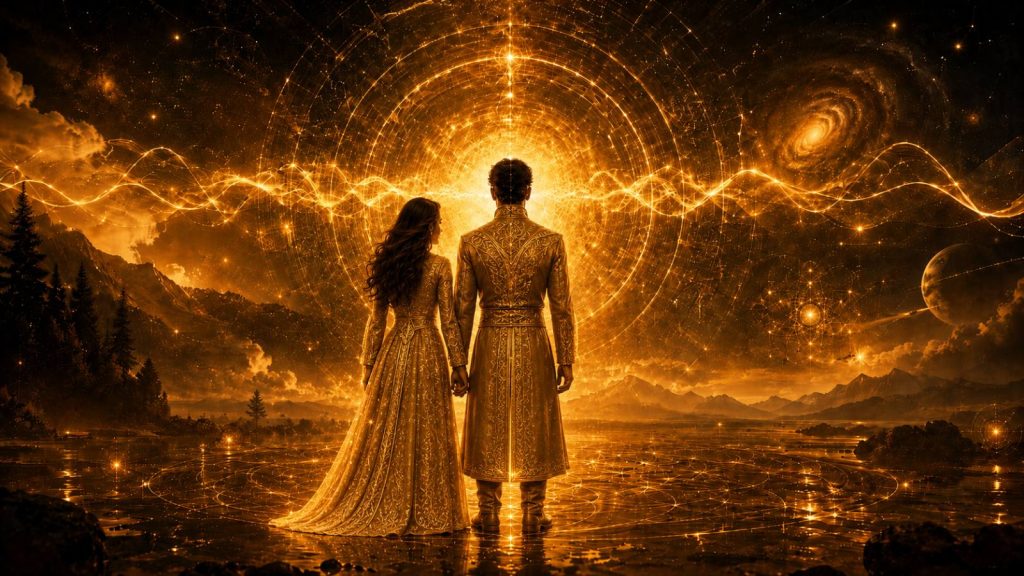
For Tesla, the universe was never static. Everything that exists — from stars and planets to the human body and thoughts themselves — exists in a state of continuous movement. Energy changes form, transfers, transforms, and connects all things.
By observing nature, Tesla recognized patterns, rhythms, and resonances. He was fascinated by waves, electromagnetism, the vibrations of the Earth, and the possibility of transmitting energy wirelessly through space. His experiments with high frequencies and resonant systems were decades ahead of the time in which he lived.
Unlike many scientists of his era, Tesla did not see nature as an enemy to conquer, but as an intelligent system whose laws should be understood. He believed humanity could learn immensely by studying natural processes because the same principles repeat themselves on every level of existence.
That is precisely why Tesla’s ideas still do not feel outdated today. In fact, many modern discussions about energy, frequency, and the interconnectedness of the universe strongly resemble the way Tesla was thinking more than a century ago.
What Does “Everything Is Vibration” Really Mean?
In scientific terms, vibration refers to oscillation or the movement of energy. Sound, light, electromagnetic waves, and even atomic particles are all connected to different forms of vibration and frequency.
However, when discussing Tesla’s philosophy, the concept takes on a deeper meaning. The idea is not limited to the physical vibration of matter, but expands into the understanding that everything is connected through energy and movement.
We often perceive the material world as solid and immovable. Yet modern physics shows that even objects appearing completely stable are composed of enormous amounts of energy in constant motion. At the atomic level, nothing is truly still.
Tesla believed human beings were not separate from this process. Our thoughts, emotions, and inner states also carry a certain “frequency,” shaping the way we interact with ourselves and the world around us.
Because of this, many later interpretations connected Tesla’s ideas with consciousness, intuition, and human potential. While debates continue around these interpretations, it is difficult to deny that Tesla viewed humanity as far more than a simple biological machine.
Energy, Consciousness, and Human Potential
Tesla was known for his extraordinary concentration, powerful intuition, and ability to visualize inventions entirely within his mind before physically building them. He claimed he could mentally test and perfect machines long before constructing them in reality.
This way of thinking continues to fascinate scientists, psychologists, and creativity researchers today.
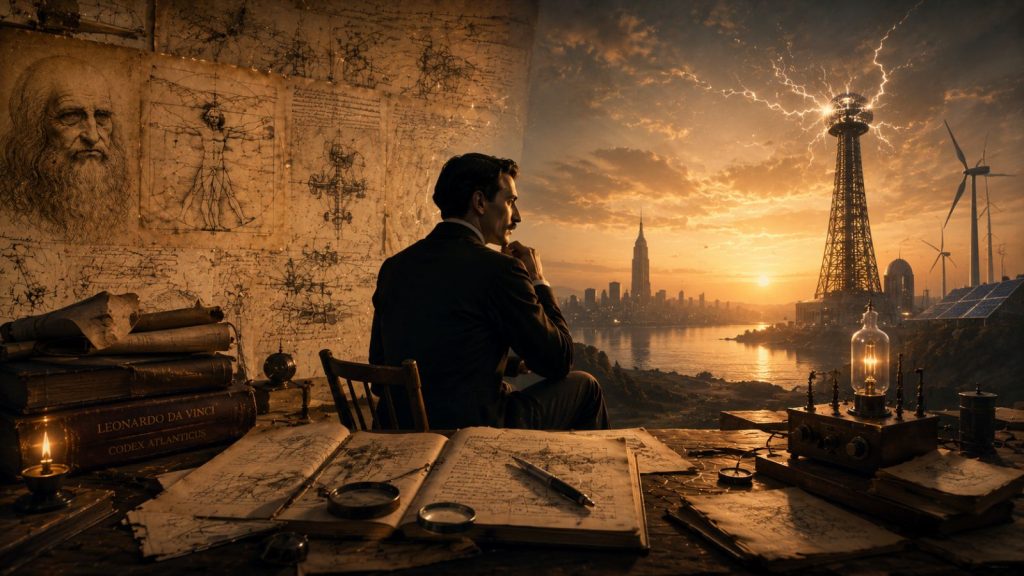
Throughout history, many great minds have described the feeling that ideas come from a deeper source of inspiration. Leonardo da Vinci, centuries before Tesla, created sketches and concepts of technologies that would not become reality until long after his death.
For this reason, Tesla and Da Vinci are often seen as individuals who thought not only logically, but intuitively and visionarily.
Tesla believed human beings possess far greater potential than they currently use. At the same time, he felt modern life distances people from their inner balance. Stress, fear, constant noise, and obsession with materialism often suppress creativity and deeper awareness.
That is why many people today interpret Tesla’s words almost as a warning to modern civilization — a reminder that it is not enough to develop technology alone; consciousness must evolve as well.
Tesla, Intuition, and Ideas Beyond Time
One reason Tesla continues to inspire fascination is the feeling that he was far ahead of his time. His ideas about wireless energy transmission, global communication, and technological interconnectedness sounded almost unbelievable in the early 20th century.
Tesla often said that he drew inspiration from nature, but also from moments of intense mental focus. He believed human beings could access higher levels of understanding if they learned to perceive reality beyond conventional patterns of thought.
This does not mean Tesla was a mystic in the traditional sense. He was first and foremost a scientist and experimenter. However, he possessed a rare ability to combine science, intuition, and imagination.
That combination is what makes him unique.
Today, some people see Tesla almost as a symbol of hidden knowledge or lost possibilities for humanity. Numerous theories, interpretations, and myths have emerged around his ideas — from free energy concepts to debates about ether and the true nature of the universe.
Although many of these claims remain scientifically unverified, they demonstrate the powerful impact Tesla left on the collective imagination of the modern world.
The Conflict Between Visionaries and Materialism
Tesla’s life was not only a story of genius, but also one of isolation. He was a man of enormous ideas, yet often struggled within the financial and political systems of his time.
While others focused on profit, Tesla focused on the future of humanity. He believed technology should serve people rather than exclusively benefiting powerful industries and financial interests.
Because of this, he frequently clashed with investors, business partners, and economic elites. Many of his ideas remained unfinished precisely because they were not considered commercially profitable.
Today, Tesla is often portrayed as the archetype of the misunderstood visionary. While part of this image has certainly been romanticized, it is true that much of the recognition he deserved only arrived after his death.
His name now appears on cars, technology companies, scientific institutes, books, documentaries, and countless discussions about the future of science and humanity. Ironically, the man who spent his final years largely forgotten has become one of the most recognizable scientific figures in modern history.
Why Tesla’s Ideas Still Fascinate Humanity
Perhaps the greatest power of Tesla’s legacy lies not only in his inventions, but in the way he forces us to think differently.
Tesla reminds humanity that reality may not be as simple as it appears. That behind the visible world there may exist a deeper system of energy, interconnectedness, and laws we are only beginning to understand.
His words about energy, frequency, and vibration have survived for generations precisely because they transcend traditional boundaries of science. They feel simultaneously rational and philosophical, technical and almost spiritual.
In a world increasingly defined by exhaustion, disconnection, and the loss of meaning, Tesla’s ideas continue to inspire people to ask larger questions. Who are we? How does consciousness truly work? How deeply are we connected to nature and the universe? Is there more beyond what we can physically see?
Perhaps Tesla did not provide all the answers.
But he opened the door to a completely different way of understanding reality.