
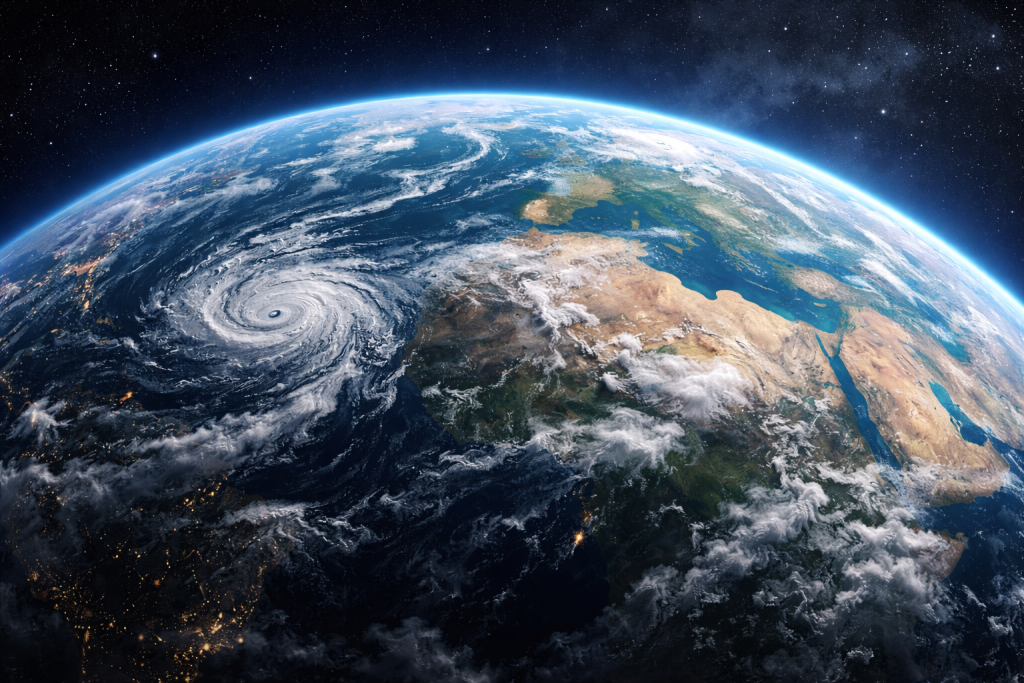
Meteorology is the science that studies the Earth’s atmosphere, the physical processes occurring within it, and weather conditions, with the primary goal of understanding and forecasting weather. As a branch of geophysics, meteorology examines atmospheric phenomena such as clouds, precipitation, wind, and electrical processes in the atmosphere, relying on principles of physics and thermodynamics.
The main subject of meteorology is the atmosphere, its changes, and their impact on weather conditions. Its objective is the analysis of the current state of the atmosphere, as well as short-term and long-term weather forecasting. Meteorology includes several subdisciplines, among them synoptic meteorology, which focuses on weather forecasting, atmospheric dynamics, and atmospheric physics.
The development of meteorology began with simple observation of the sky and weather phenomena and gradually evolved into a modern science that uses satellites, radar, and computer models to analyze storms, cyclones, and temperature changes.
Meteorology or Weather Science
Meteorology, also known as weather science, is the study of the Earth’s atmosphere and the changes occurring within it. Its roots as a scientific discipline date back to the mid-seventeenth century, when the first instrumental measurements of meteorological phenomena began.
It studies various forms of precipitation, thunderstorms, tornadoes, tropical cyclones, and typhoons, as well as the impact of weather conditions on humans and human activities. A particularly important shared field between meteorology and oceanography is the study of interactions between the atmosphere and the oceans.
Historical Development of Meteorology
The earliest beginnings of meteorology are linked to humanity’s ancient interest in natural phenomena. In early cultures, weather events were explained through mythical forces, and such beliefs have persisted among some peoples even today.
The term meteorology comes from the Greek word meteoron, referring to all phenomena occurring in the sky. Already in ancient China, India, Egypt, and Greece, people discussed winds, precipitation, and weather changes. The first systematic work describing these phenomena appears in Aristotle’s Meteorology, written in the fourth century BCE. Because of this, Aristotle is often considered the founder of meteorology, and his influence remained strong throughout antiquity and the Middle Ages.
For many centuries afterward, meteorology developed slowly. Records from that period mainly consist of chronicles describing extreme weather events, without instrumental measurements. Weather forecasting was largely based on observation and short-term expectations.

Transition to Instrumental Meteorology
A major turning point occurred in the seventeenth century when speculation began to be replaced by measurement. Galileo’s students initiated the first systematic meteorological observations using instruments. The barometer, thermometer, and hygrometer came into use, and measurements intensified between the mid-seventeenth and eighteenth centuries.
The development of meteorology was closely linked with advances in theoretical physics. Newton’s laws of motion, research on gases, and studies by Halley, Hadley, and d’Alembert on atmospheric circulation established the scientific foundations for understanding the atmosphere. In the late seventeenth century, Halley published the first map of trade winds in tropical regions, which was of great importance for maritime navigation.
In the nineteenth century, the synoptic method was introduced, involving simultaneous observation of atmospheric conditions over large areas. National meteorological services were established, and synoptic weather maps enabled more reliable forecasting.
Milutin Milanković and the Problem of Earth’s Polar Shifts
The question of why Europe lacks clear traces of ice ages found in some other parts of the world long attracted scientific attention. One explanation was proposed by Alfred Wegener, who argued that continents once formed a single landmass and later drifted apart. According to this theory, the Earth’s rotational axis remained stable while continents moved.
Such assumptions required a solid astronomical and mathematical-physical foundation. Wegener therefore turned to Milutin Milanković, already a recognized scientist in cosmic climatology. Milanković began a thorough study of the problem in 1925.
After extensive work, he concluded that the Earth’s crust can shift relative to the rotational poles while the orientation of the Earth’s axis in space remains essentially unchanged. This solution aligned with earlier geological findings and contributed to a better understanding of Earth’s climatic history.
Milanković explained that, according to the laws of rational mechanics, the orientation of the Earth’s axis in space may be considered constant, while shifts occur on the Earth’s surface itself. From Earth’s perspective, it appears that the poles slowly move across the planet’s crust, influencing the distribution of solar energy and long-term climate changes.
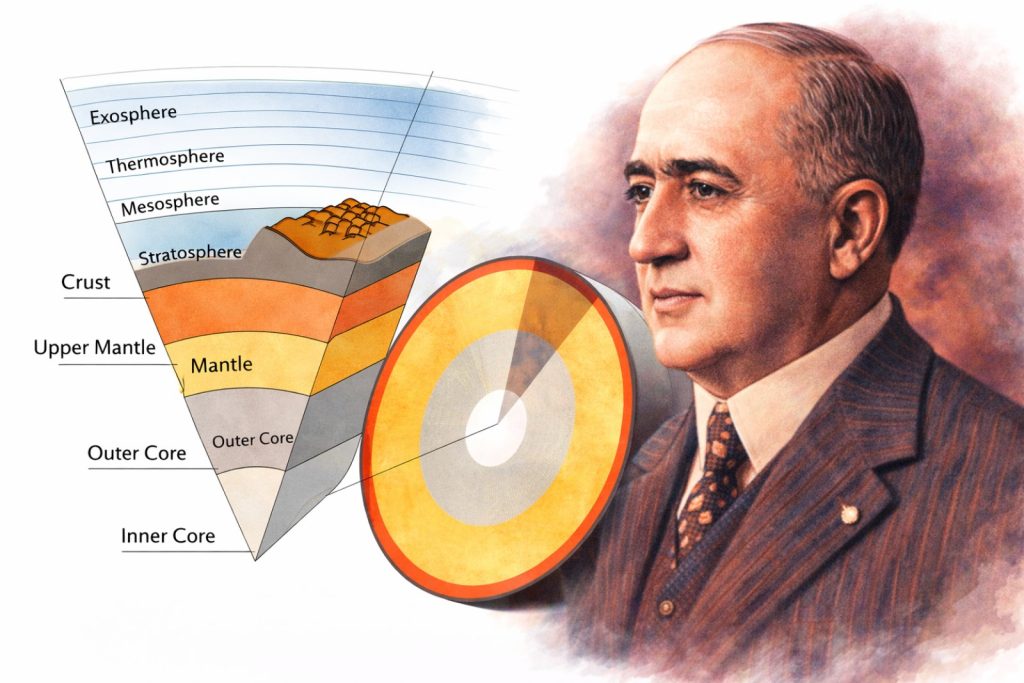
Nikola Tesla and His View of the Earth
Nikola Tesla, even without direct experimental evidence, considered the Earth an isolated body possessing its own electrical charge. He believed that, like other celestial bodies, the Earth formed through processes of mechanical separation and must have retained an electrical charge in the process.
Such reflections point to a deep interconnection between mechanical, electrical, and cosmic processes in nature, which both Tesla and Milanković, each in their own way, sought to understand and explain.