
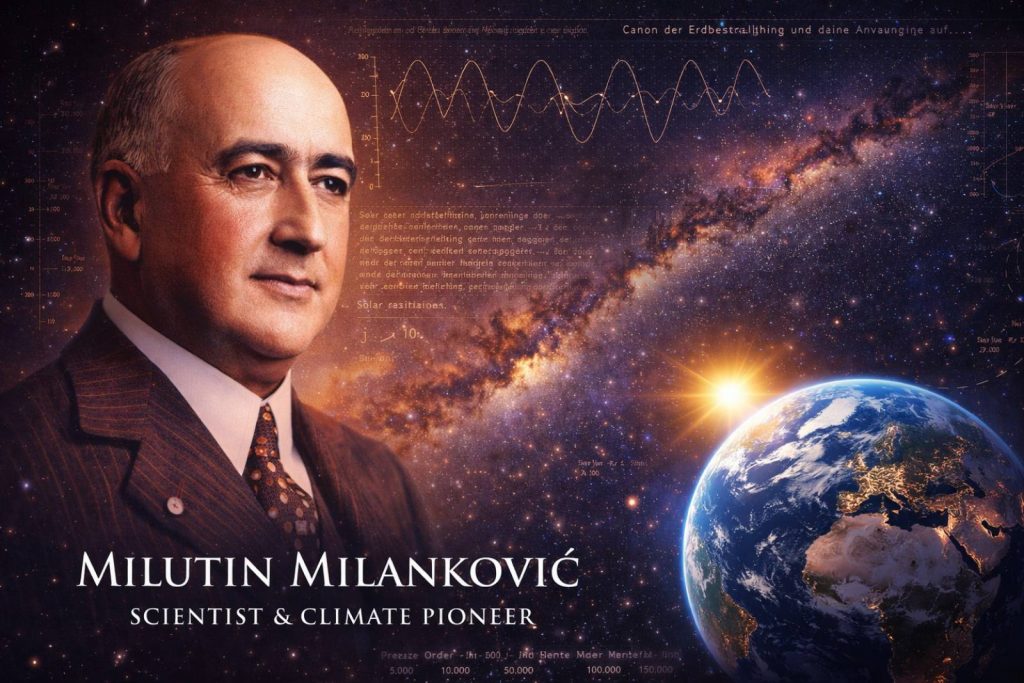
Milutin Milanković was aware that his astronomical theory of climate change had been successfully completed, yet the papers related to it were scattered across various publications. He therefore decided to gather them and publish them in a single, unified volume. He believed his work would remain incomplete unless he consolidated all previous studies into a coherent whole and supplemented them with the many geological applications his theory had inspired.
In early 1939, he began working on his monumental book The Canon of Earth’s Insolation. Within it, he summarized decades of scientific research, detailed calculations, and his unwavering faith in mathematical precision and scientific reasoning. The work reflects his thoroughness, persistence, and confidence in the correctness of his approach, as well as his belief that one day universal scientific recognition would follow.
The book is divided into six major sections.
The first section examines planetary motion, the movement of the Sun, and the mutual perturbations of these motions, addressing fundamental problems of celestial mechanics using newly developed mathematical tools.
The second section focuses on Earth’s rotation, including daily rotation, precession, and nutation of the Earth’s axis.
The third section discusses the secular movement of the poles of Earth’s rotation, presenting cartographic and tabular results.
The fourth section, titled Earth’s Insolation and Its Secular Changes, presents the results of Milanković’s extensive investigations of solar radiation.
The fifth section establishes the connection between Earth’s insolation and surface temperature, outlining the principles of his mathematical theory of climate and its applications.
The sixth section addresses the Ice Ages — their mechanisms, chronology, and the relevant scientific literature available at the time.
Writing the Canon
Milanković worked on this book for approximately two years. The printing of The Canon of Earth’s Insolation and Its Application to the Problem of Ice Ages was completed on April 2, 1941. He understood the magnitude of the undertaking but was not discouraged. He believed he was in the ideal stage of life — experienced enough for such a demanding task, yet still confident and determined.
Persistent Scientific Work
Drawing upon theoretical physics, celestial mechanics, and his exceptional mathematical talent, Milanković was the first to mathematically explain the process of glaciation. He demonstrated that long-term (secular) variations in solar radiation were the principal cause of major climate changes on Earth. In 1944, an extensive review of his work was published in a German meteorological journal by Karl Wundt and his collaborators, providing strong scientific support for his theory.
Scientific Confirmation
Milanković did not live to see full recognition of his theory. For years, it was disputed or ignored. Decades after his death, however, new empirical evidence emerged. Research on deep-sea sediment cores and paleoclimatic data in the 1970s confirmed that climate variations corresponded to changes in orbital eccentricity, axial tilt, and precession — precisely as Milanković had calculated.

Milanković Cycles and Earth’s Climate
His astronomical theory enables not only the reconstruction of past climate changes but also projections of future climate trends. The last major Ice Age ended approximately 25,000 years ago, when global temperatures were about 6°C lower than today. This was followed by a warming period and a climatic optimum between roughly 5000 and 2500 BCE. Later, the so-called Little Ice Age occurred, lasting approximately from 1500 to 1850 CE.
Mathematical Model of Climate Change
Milanković developed a mathematical framework capable of analyzing insolation changes over a period of one million years, and his theory is applicable to Earth’s entire geological history. It provided an explanation for both glacial and interglacial periods, as well as evidence of ancient climate maxima and minima.
The Present State of the Climate System
Contemporary climate change does not fully align with natural climatic cycles. Earth’s climate system includes the atmosphere, ice cover, oceans, and biosphere. Changes in any of these components influence the others, often with significant consequences for life on Earth.
The natural greenhouse effect, caused by gases such as carbon dioxide, methane, water vapor, and ozone, maintains Earth’s average temperature at approximately +14°C. Without this effect, the average temperature would be around –18°C. However, human activities over the past two centuries have significantly increased greenhouse gas concentrations, leading to additional global warming.
Current projections indicate that global temperatures may rise between 1.8°C and 4°C by the end of the 21st century. Such changes pose serious challenges for ecosystems and human societies alike.
The Balance of Solar Radiation
Earth’s climate is governed by a balance between incoming solar radiation and outgoing terrestrial radiation. Any long-term disturbance of this balance results in climate change. The amount of solar radiation received depends on geographic latitude, the angle of incidence of sunlight, and the length of daylight throughout the year.
The Importance of Milanković’s Theory Today
As Wladimir Köppen foresaw in the early 20th century, Milanković’s theory became an indispensable tool in paleoclimate research. Today, it remains fundamental in studying future climate change, particularly in understanding the interaction between natural orbital variations and anthropogenic influences shaping Earth’s climate system.