Introduction
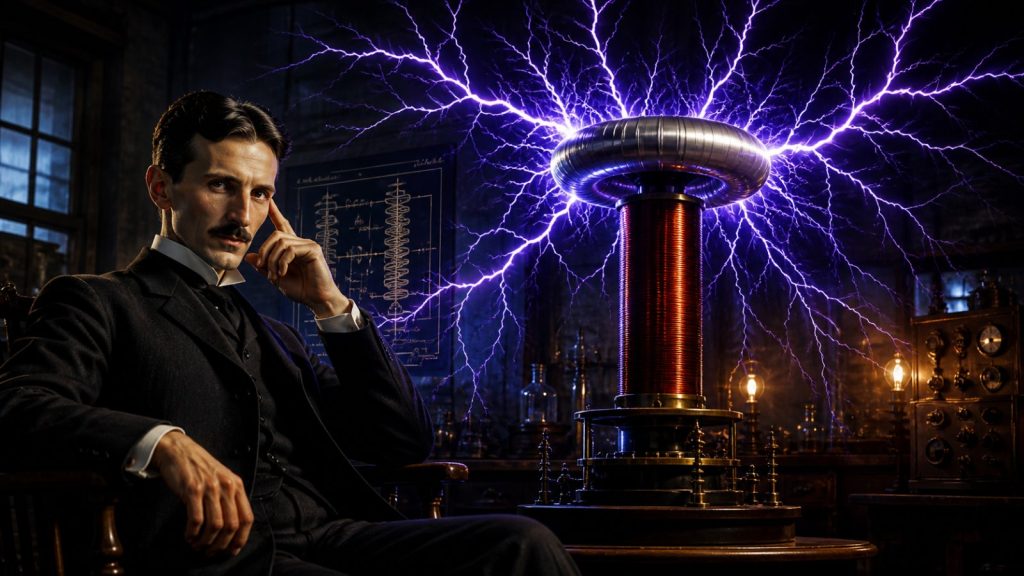
The Tesla coil is one of the most recognizable devices in electrical engineering, developed in the late 19th century by Nikola Tesla. It is capable of generating extremely high voltages and high-frequency currents, producing spectacular electrical arcs that resemble lightning.
Although today it is mostly used for educational and demonstration purposes, the Tesla coil is based on serious physical principles such as resonance, electromagnetism, and energy transfer.
1. What is a Tesla coil?
A Tesla coil is a resonant transformer that generates very high voltages with relatively low currents. It consists of two coupled electrical circuits — a primary and a secondary circuit — tuned to the same resonant frequency.
The primary circuit contains a capacitor and a coil, while the secondary circuit has a large number of turns and is responsible for voltage amplification. When both circuits are properly tuned, energy is transferred very efficiently between them.
2. How does a Tesla coil work?
The operation of a Tesla coil is based on rapid energy discharge and resonance.
A capacitor in the primary circuit stores electrical energy. Once the voltage becomes high enough, the spark gap allows a sudden discharge. This creates high-frequency oscillations in the primary circuit, which are then transferred to the secondary circuit through electromagnetic coupling.
Because the secondary coil has many more turns than the primary coil, the voltage rises to an extremely high level. When the voltage becomes strong enough, the surrounding air ionizes and visible electrical arcs appear.
In simple terms, the Tesla coil stores energy, releases it suddenly, and uses resonance to build up very high voltage.
3. Origin of the Tesla coil
The Tesla coil was developed in 1891 as part of Nikola Tesla’s research into high-frequency and high-voltage currents. Tesla was searching for a way to transmit energy without wires, which was a revolutionary idea at the time.
Conventional iron-core transformers could not operate efficiently at the high frequencies Tesla wanted to use. Because of that, he designed a new type of transformer with an air core and resonant circuits.
His experiments showed that electrical energy could be transmitted wirelessly over short distances, and the Tesla coil became one of the key devices in his work on wireless power, lighting, and early radio technology.
4. Electrical circuit of a Tesla coil
A Tesla coil consists of three main parts:
- a power source, usually a high-voltage transformer
- a primary circuit, made of a capacitor, primary coil, and spark gap
- a secondary circuit, made of a secondary coil, toroid, and grounding system
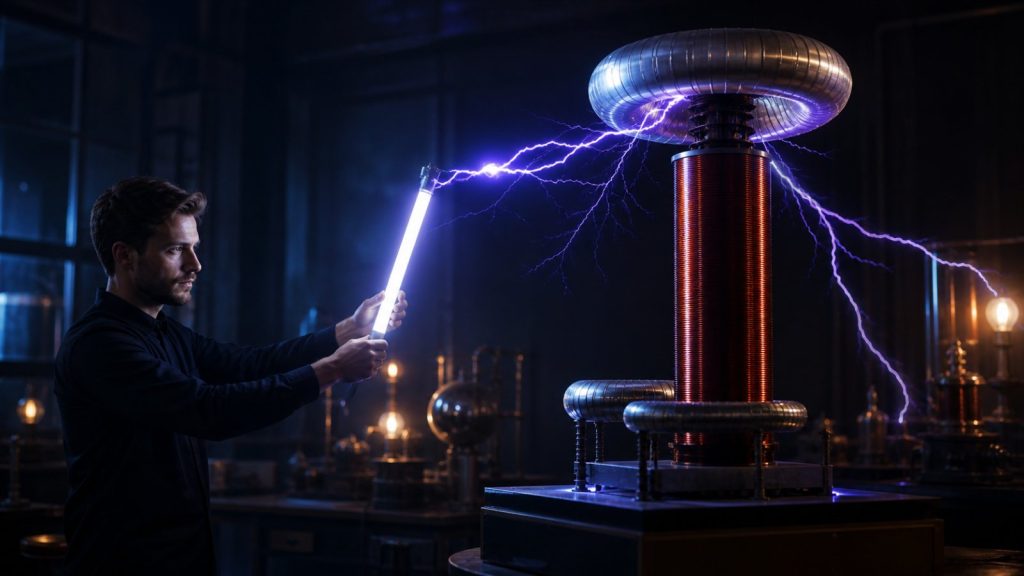
The power source charges the capacitor in the primary circuit. When the voltage becomes high enough, the spark gap fires and the stored energy is released into the primary coil. This creates fast electrical oscillations.
The secondary circuit is tuned to the same resonant frequency, allowing energy to transfer from the primary coil to the secondary coil. The toroid at the top helps control the electric field and allows larger, more stable electrical discharges.
5. Frequency of a Tesla coil
The resonant frequency of a Tesla coil depends on the inductance and capacitance of its circuits. The basic formula is:
f = 1 / (2π√LC)
where:
- f is the resonant frequency
- L is inductance
- C is capacitance
For efficient operation, the primary and secondary circuits must be tuned to the same frequency:
f₁ = f₂
In an ideal LC circuit, the relationship between inductance and capacitance determines how the circuit oscillates. However, real Tesla coils are not perfect. They lose energy through heat, sound, sparks, electromagnetic radiation, and resistance in the components.
Because of these losses, the real operating frequency is not always exactly the same as the theoretical value. In practice, Tesla coils usually operate from several tens of kilohertz to several megahertz, depending on their size, design, and capacitance.
6. Advantages and disadvantages of Tesla coils
Advantages
Tesla coils can generate extremely high voltages and create long, bright electrical arcs. This makes them very useful for demonstrations and education.
They are also excellent for showing important electrical principles such as resonance, electromagnetic fields, high-frequency currents, and wireless energy transfer over short distances.
Another advantage is that Tesla coils use an air-core design, which allows them to work at high frequencies without the heavy iron cores used in conventional transformers.
Disadvantages
The main disadvantage of a Tesla coil is safety. High voltage can be dangerous, and improper handling can cause serious injury, burns, electric shock, or damage to nearby equipment.
Tesla coils can also be difficult to build and tune correctly. They often require precise adjustment of capacitance, coil dimensions, grounding, and spark gap spacing.
Another drawback is electromagnetic interference. A working Tesla coil can disturb radios, wireless devices, computers, and other nearby electronics.
7. Applications of Tesla coils
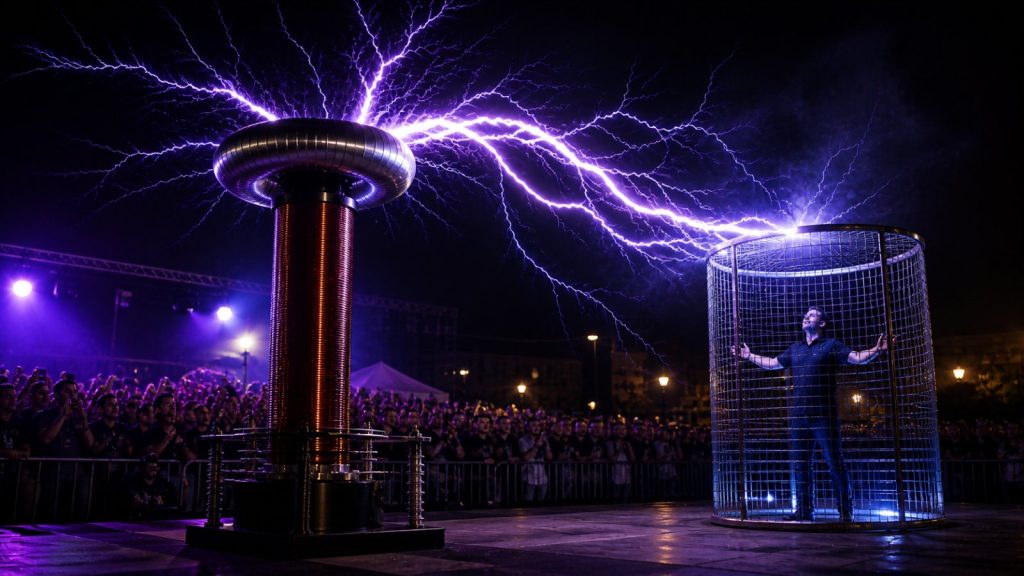
Tesla coils are most commonly used for scientific and educational demonstrations. They are often seen in classrooms, museums, laboratories, and science shows because they make invisible electrical principles visible.
They are also used in entertainment, especially in stage performances, films, and special effects, where dramatic electrical arcs create a strong visual impact.
In research settings, Tesla coils can be used to study high voltage, electrical discharge, plasma, insulation breakdown, and electromagnetic fields.
Historically, Tesla coils were also connected with early wireless communication experiments and early high-frequency medical devices. Today, those uses are mostly historical, but they show how important Tesla’s work was for later electrical technologies.
Some Tesla coil systems can also generate ozone, although this must be done carefully and in controlled conditions because ozone can be harmful in high concentrations.
8. Types of Tesla coils
There are several main types of Tesla coils.
Spark gap Tesla coil
The spark gap Tesla coil is the classic version. It uses a spark gap to discharge the primary capacitor and create high-frequency oscillations. This is the oldest and most traditional type.
Solid-state Tesla coil
A solid-state Tesla coil uses electronic components such as transistors instead of a mechanical spark gap. It is usually more controllable and can be designed for music, demonstrations, or compact experiments.
Dual resonant solid-state Tesla coil
A dual resonant solid-state Tesla coil, often called DRSSTC, is a more advanced version. Both the primary and secondary circuits are resonant, which allows greater efficiency and more powerful arcs.
Mini Tesla coil
Mini Tesla coils are small educational versions used for simple experiments and demonstrations. They are usually much less powerful than full-size Tesla coils, but they are easier to build and safer when properly designed.
9. Spark distance and air breakdown
The length of a spark depends mainly on voltage, but also on humidity, air pressure, electrode shape, frequency, and the surrounding environment.
Under standard conditions, air breaks down at approximately:
3 kV per millimeter
This means that, in ideal conditions, a voltage of around 300 kV could produce a spark of roughly 10 cm. In real Tesla coils, however, spark length is not determined by voltage alone. Coil power, tuning, toroid shape, and discharge conditions also play an important role.
Because of that, spark distance should be treated as an estimate, not as a perfect measurement of voltage.
10. Tesla coil and Van de Graaff generator
A Tesla coil and a Van de Graaff generator can both produce high voltage, but they work in very different ways.
A Tesla coil produces high-frequency alternating current. It creates electrical arcs, electromagnetic fields, and visible discharges that change rapidly over time.
A Van de Graaff generator produces high-voltage direct current through electrostatic charge accumulation. It is commonly used in demonstrations of static electricity, such as making hair stand up or showing electrostatic attraction and repulsion.
In short, a Tesla coil is a high-frequency resonant transformer, while a Van de Graaff generator is an electrostatic generator.
11. Conclusion
The Tesla coil is not just a visually impressive device. It is also an important tool for understanding resonance, high voltage, electromagnetic fields, and wireless energy transfer.
Although it no longer has broad industrial use, its educational and experimental value remains significant. Tesla coils continue to appear in science demonstrations, research, entertainment, and engineering education.
More than a century after its invention, the Tesla coil still represents Nikola Tesla’s vision of electricity as a force that could be explored, transmitted, and understood in new and extraordinary ways.