
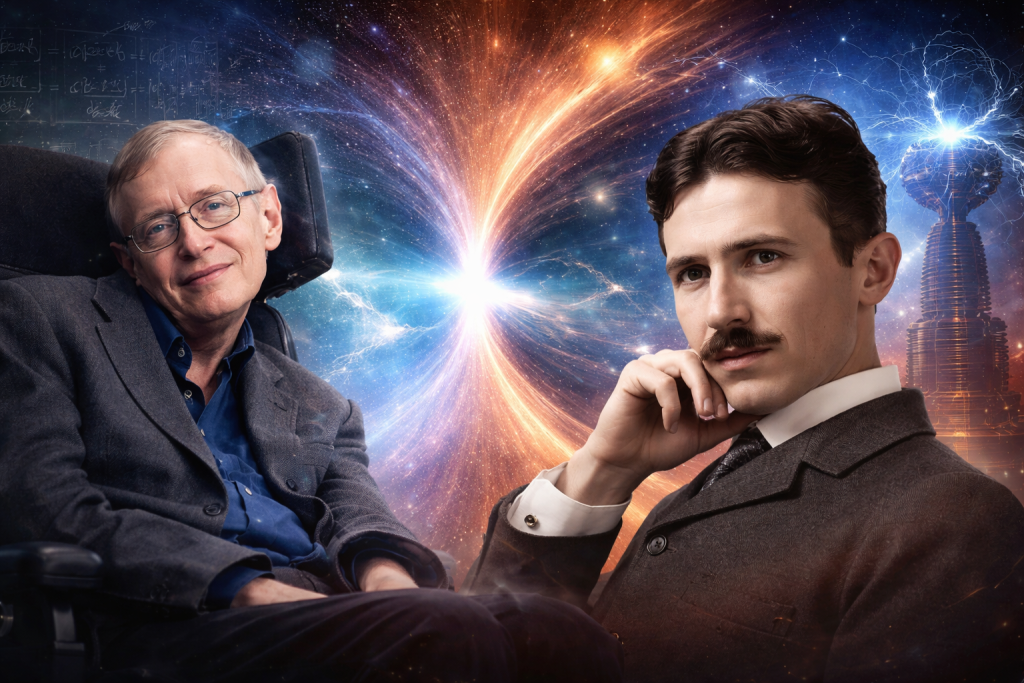
Introduction: Why Stephen Hawking Still Matters Today
Stephen Hawking’s name has long moved beyond the boundaries of science. Even people who have never opened a physics book know who he is. Not because of marketing, but because of a rare combination: a deep understanding of the universe and a life that defied all limitations.
At first glance, Hawking and Nikola Tesla seem like completely different types of geniuses. One was a theoretical physicist exploring black holes, the other a visionary working with energy and electricity. But what connects them is their way of thinking — both sought to understand the fundamental laws of reality, not just their consequences.
This article does not skim the surface. It focuses on what people actually search for: how Hawking thought, what he left behind, and why his ideas still matter.
The Life of Stephen Hawking: A Mind Beyond Physical Limits
Stephen Hawking was born in 1942 in Oxford. From an early age, he showed an interest in mathematics and physics, although he was not the typical “school genius” who excels at everything. His strength was in thinking, not in academic performance.
The turning point came in his early twenties when he was diagnosed with ALS. Doctors gave him only a few years to live. Instead, he lived for decades and produced work that reshaped modern physics.
As the disease progressed, he lost control over his body, but not over his mind. This is the core of his story. He did not become a symbol because of illness, but because illness did not define his work.
This is why many people search for biography of Stephen Hawking pdf — not just for facts, but to understand how someone could operate at such a level under those conditions.
Stephen Hawking IQ and the Real Measure of Intelligence
A common question is: what was Stephen Hawking’s IQ? It is often estimated to be around 160.
But this is the wrong focus.
IQ alone does not explain Hawking. There are many people with high IQs who never create anything meaningful. What set him apart was his ability to simplify complex ideas without losing their essence.
There is a clear parallel with Tesla here. Tesla never built his identity around IQ. His value was in vision and understanding.
The same applies to Hawking: the number is irrelevant — what matters is how the mind is used.
A Brief History of Time: The Book That Brought the Universe to the Masses
A Brief History of Time is one of the few scientific books that became a global bestseller. That is not accidental.
Most scientific work stays within academic circles. Hawking did something different — he translated complex physics into language that ordinary people could understand.
In this book, he explains:
- the nature of time
- black holes
- the origin of the universe
- the fundamental laws of physics
And he does it without oversimplifying to the point of distortion.
When people search for stephen hawking book, this is usually the one they find first. But it is not his only work. Books like The Universe in a Nutshell and The Grand Design expand on these ideas.
The difference is simple: Hawking didn’t write to impress — he wrote to explain.
Global Fame: How Science Entered Pop Culture
Hawking became one of the most recognizable figures in science worldwide. He appeared in TV shows, documentaries, and public events. His synthesized voice became iconic.
But his fame was not based on charisma. It came from something much rarer — a scientist who understands complex ideas and can communicate them clearly.
This highlights a key difference compared to Tesla. Tesla was largely unrecognized in his time and gained recognition later. Hawking managed to connect science with the public during his lifetime.
Hawking’s Warnings About the Future of Humanity
Unlike the stereotype of a detached scientist, Hawking often spoke about the future of humanity.
His warnings were clear:
- artificial intelligence could become dangerous if uncontrolled
- climate change poses serious risks
- humanity should consider life beyond Earth
He was not alarmist without reason. His approach was rational: if we understand the risks, we can act.
Hawking: There Is Hope — But Only If We Act Now
Despite his warnings, Hawking was not pessimistic.
His central message was simple: the future is not predetermined. Humans have the ability to change direction, but only if they act in time.
Science and technology are not threats by themselves. The real danger lies in using them without understanding or responsibility.

What Else Did Hawking Say: Ideas Often Overlooked
Beyond major topics, Hawking often emphasized simple but important ideas.
He highlighted:
- curiosity
- asking questions
- embracing the unknown
His view of the universe was not mystical. He was not searching for hidden meanings, but for the laws governing reality.
This is another point of contrast with Tesla, who often leaned toward a more intuitive and philosophical perspective.
Stephen Hawking and Nikola Tesla: Two Types of Genius
At first glance, Hawking and Tesla belong to different worlds.
Hawking worked with mathematical models describing the universe. Tesla worked with energy, electricity, and real-world inventions.
But they share a common goal: understanding the structure of reality.
The difference lies in approach:
- Tesla thought in visions and intuition
- Hawking thought in mathematics and logic
Both paths lead to deeper understanding.
Conclusion: The Lesson Most People Miss
Most people look at Hawking through the lens of his illness or fame. That misses the point.
His true value lies in how he thought — in his ability to ask the right questions and reject simple answers.
In that sense, he is closer to Tesla than it first appears.
Geniuses do not give final answers. They change the way we see the problem.
That is why Stephen Hawking still matters — not as a historical figure, but as a reference point for a way of thinking that is still rare today.