Introduction: Why the Question of Governance Is No Longer Only a Political Question
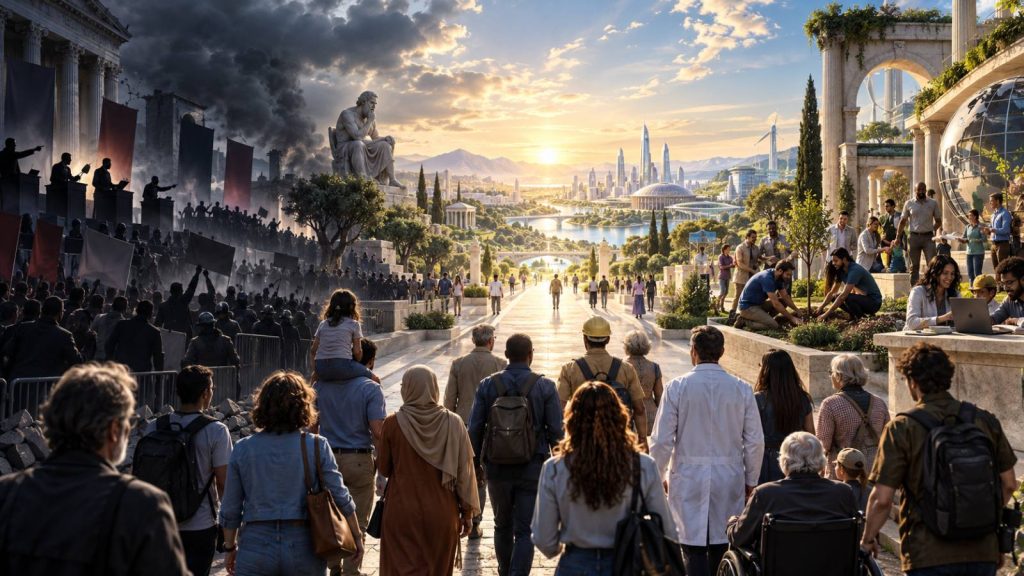
For centuries, humanity has been searching for the best form of social order. Throughout history, emperors, kings, empires, republics, parliaments, ideologies, parties, and political systems have come and gone, each promising freedom, order, justice, and a better life for the people. In theory, every system begins with the claim that it wants to organize society and protect the human being. In practice, many of them eventually become arenas of struggle for power.
Today, democracy is most often presented as the highest form of political freedom. It is based on the idea that the people have the right to choose, decide, and participate in government. In its basic intention, this idea has great value. The people must not be slaves to power. Government must not exist above the human being. A political system should serve people, not the other way around.
However, the question that is increasingly being raised today is this: how much has modern democracy truly remained the rule of the people, and how much has it turned into the rule of political circles over the people?
If the people vote every four years and then remain powerless before the decisions of political elites, then democracy becomes only a form. If elections turn into a battle of campaigns, promises, party interests, and media manipulation, then the voice of the people is no longer fully free. If politicians speak in the name of the people, but after elections serve their own survival, interest groups, or centers of power, then we must ask: is a formal political model enough, or does humanity need a higher principle?
This is where we come to the concept of mirocracy.
Mirocracy can be understood as the rule of peace. Not as an ordinary political ideology, not as another party, and not as another system that would replace one form of power with another. Mirocracy is, above all, a civilizational principle. It places peace at the foundation of all decisions, all laws, all relationships among people, and all relationships among nations.
If democracy is, at least in theory, the rule of the people, then mirocracy should be the voice of humanity that no longer wants to live in constant fear, division, wars, manipulation, and political struggle for domination.
Democracy as an Ideal and Democracy as a Problem in Practice
Democracy should not be rejected superficially, nor should it be viewed only through its weaknesses. Historically, the democratic idea was an important step forward compared to tyranny, absolutism, violent rule, and systems in which the ordinary person had no voice at all. The right to vote, freedom of speech, political participation, and the protection of civil rights represent significant civilizational values.
The problem, therefore, is not in the idea itself that the people should have the right to decide. The problem appears when that idea is emptied of real substance in practice.
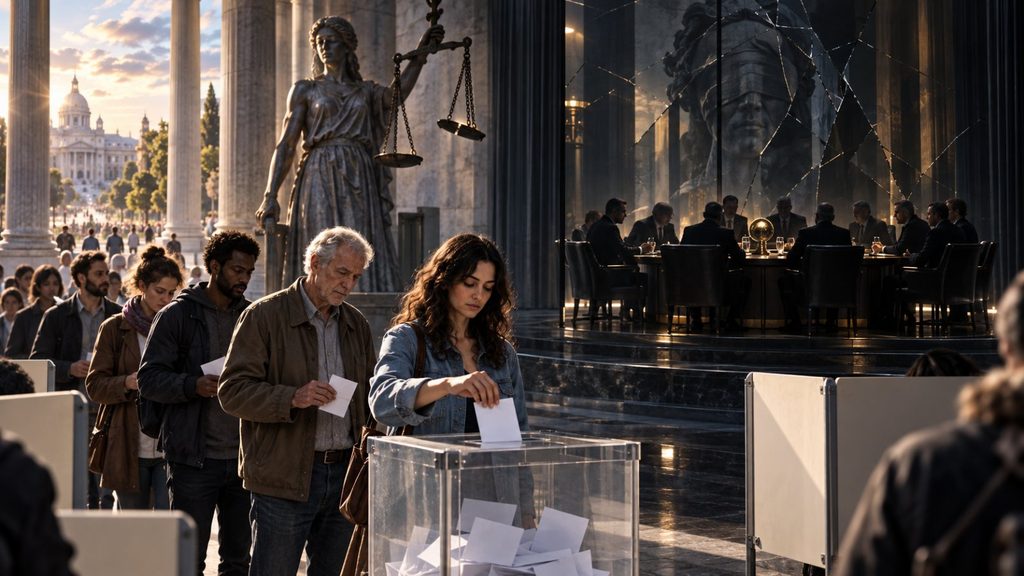
In many societies, the people formally elect the government, but they do not feel that they truly control their own destiny. Political parties become closed circles. Elections become competitions of marketing, money, influence, and media image. Citizens often choose between offered options, but they do not decide on the true direction of society.
Then democracy turns into a system in which the people are invited only when power needs legitimacy. After that, decisions are made in political offices, party structures, economic interest circles, and international centers of influence.
Such democracy can have all the external symbols of freedom and still produce a feeling of powerlessness. A person has the right to vote, but does not feel truly heard. A person has the right to choose, but often chooses between different forms of the same political logic. A person has the right to criticize, but the system rarely changes in its depth.
That is why it is becoming increasingly clear that the question of the future is not only: how do we preserve democracy? The question is also: how do we raise democracy to a higher moral and civilizational level?
If democracy remains only a struggle for power, it will not be enough. If it becomes a space of real responsibility, peace, rights, freedom, and the common good, then it moves closer to what we here call mirocracy.
Nations Are Not the Problem — the Problem Is the Politics of Conflict
One of the most important truths that must be clearly stated is that the nations of the world, in their essence, are not enemies of one another. Ordinary people, regardless of country, language, religion, or culture, usually want very similar things. They want a peaceful life, security, family, health, work, freedom, dignity, and a future for their children.
A mother from one nation does not love her child less than a mother from another nation. A worker from one country does not want less dignity than a worker from another country. An ordinary person anywhere in the world does not dream of war, hunger, exile, fear, and hatred. He wants a normal life.
Differences among nations exist. They can be seen in language, tradition, customs, history, religion, culture, and ways of life. But differences themselves are not the problem. They can be the richness of humanity. The problem begins when differences are turned into weapons of political manipulation.
The politics of conflict lives from divisions. It creates enemies, produces fear, maintains tension, and convinces people that they are threatened by one another. When a people lives in fear, it is easier to control. When society is divided, it is easier to govern. When people fight against one another, they see less clearly those who benefit from that fight.
That is why we must distinguish between the people and the political structures that speak in their name. Nations often want peace, but political elites produce conflict. Nations want cooperation, but centers of power maintain hostility. Nations want security, but politics often offers them fear as a permanent condition.
Mirocracy begins from the opposite assumption: nations are not naturally condemned to conflict. People can live next to one another, cooperate, trade, create, learn, and develop without the constant need to see one another as a threat.
If the politics of conflict has taught nations to fear one another, then mirocracy should teach humanity that peace is not weakness, but the highest form of maturity.
What Is Mirocracy?
Mirocracy can be defined as the rule of peace. But that definition is not enough if we understand peace only as the absence of war. Peace is not merely a state in which no shots are being fired. Peace is a much deeper concept. It includes justice, freedom, responsibility, security, dignity, trust, and the possibility of normal human development.
In democracy, the main question is often: who has the majority?
In mirocracy, the main question would be: does a certain decision protect peace, human dignity, freedom, justice, and the future of life?
That is a great difference. A majority can make a decision that creates division. A majority can support a wrong policy if it is frightened, manipulated, or insufficiently informed. A majority can be guided by emotions, propaganda, or short-term interests. That is why the number of votes alone is not sufficient as the highest moral criterion.
Mirocracy does not abolish the will of the people. On the contrary, it seeks to raise it to a higher level. The people should not be a mass used in political cycles, but a conscious community of human beings that demands peace, responsibility, and service to the common good from every form of power.
From this perspective, a government would not be successful because it defeated an opponent. It would be successful if it reduced fear, reduced injustice, reduced poverty, prevented conflicts, protected human rights, and opened space for development.
Mirocracy is therefore not only a political model. It is a measure of society’s maturity. It asks: does the system create peace or produce constant tension? Does it protect the human being or use him as voting mass? Does it open the future or preserve old conflicts?
If democracy can be captured in the hands of political circles, mirocracy demands that politics be returned to the human being, to life, and to peace as the highest value.
Socrates and the Question of Wise Governance
When speaking about governance, justice, and responsibility, it is useful to return to ancient philosophy and the question raised by Socrates. Not because we should claim that Socrates spoke about mirocracy as a modern concept, but because even then there was a deep suspicion of power that lacks wisdom and moral maturity.
Socrates warned that it is not enough for someone to have power, position, or popularity. The important question is whether that person knows what is good, what is just, and what benefits the community. Power without virtue can become dangerous. Popularity without wisdom can mislead the people. Political strength without inner responsibility can destroy society.
This question may be more important today than ever before. Modern politics often rewards the ability to persuade, perform, campaign, maneuver, and win positions. But it rarely asks deeply enough whether the one who governs has peace within himself, wisdom in decision-making, and responsibility toward people.
Mirocracy sets a different criterion precisely here. It is not enough to win an election. It is not enough to speak in the name of the people. It is not enough to have a majority. Power must be capable of calming conflicts, speaking the truth, protecting the weaker, making long-term decisions, and preserving the dignity of all people.
Socrates reminds us that society cannot be healthy if it is led by people who do not know their own soul, do not examine their own motives, and do not understand the responsibility of power. Mirocracy brings that thought into the modern world: power that does not serve peace, even when formally elected, remains insufficient.
Wise governance is not the one that wins the loudest. Wise governance is the one that prevents society from falling into fear, hatred, and violence.
Mirocracy as a Condition of Freedom and Human Rights
Peace is not a decoration of politics. Peace is the foundation of freedom. Without peace, there are no real human rights. In a state of war, fear, or constant crisis, rights are most easily restricted. People are told they must remain silent for the sake of security. Freedom is reduced because of extraordinary circumstances. Criticism is declared dangerous. A different opinion becomes a threat.
That is why systems that constantly produce fear cannot protect freedom in the long term. They may speak about freedom, but at the same time they create conditions in which a person is afraid to think, speak, and live freely.
Mirocracy places peace as the first condition of human rights. A person has the right to live without constant fear. A person has the right to dignity. A person has the right to freedom of thought. A person has the right to work, family, security, movement, education, and life in a community that does not push him into hatred toward others.
If politics constantly divides people, it threatens human rights even when it formally speaks about them. If society is constantly kept in tension, a person can never fully develop his abilities. If power survives on fear, then freedom becomes only a word.
That is why mirocracy does not only ask whether laws about rights exist. It asks whether a person truly lives in conditions of peace, dignity, and security. Because a right that exists on paper but not in real life is not enough.
Freedom is not only the possibility for a person to circle a name on a ballot once every few years. Freedom is the possibility to live without humiliation, without manipulation, without constant fear, and without the feeling that one’s life is only a tool in the hands of political interests.
Mirocracy and the Future of the Entire Civilization
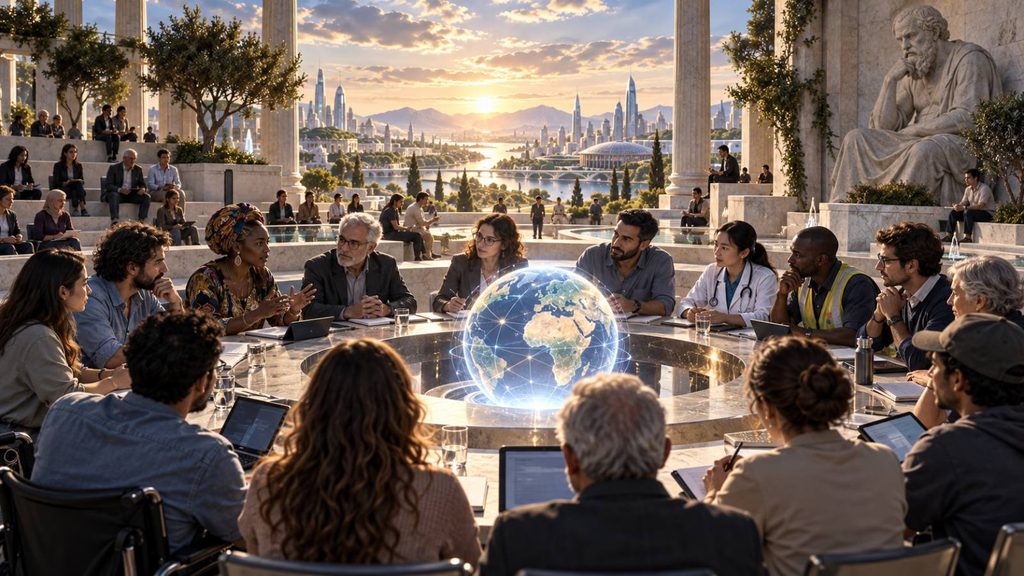
Mirocracy is not important only for politics. It is important for the entire future of humanity. Today’s civilization is entering a period of great technological change. Artificial intelligence, energy, biotechnology, digital surveillance, climate change, migration, and the global economy are opening questions that the old politics of conflict can no longer solve.
If humanity continues to act through the logic of domination, every new technology will become a new means of control. If it continues to act through the logic of struggle for resources, every crisis will become a reason for new conflicts. If it continues to live in divisions, development will turn into danger.
That is why peace is necessary as the foundation of a new civilizational direction.
In previous reflections on Tesla, energy, open innovations, and responsibility, the same message often returned: great power requires great awareness. Free energy without peace could become a danger. Technology without morality could become a weapon. Knowledge without responsibility could serve control instead of liberation.
Mirocracy is therefore a natural continuation of that thought. It says that humanity cannot enter a higher technological stage if it remains trapped in the old political pattern of conflict. A civilization that wants free energy, sustainable development, and true progress must first learn to preserve peace.
Peace is not the end of development. Peace is the condition of development. While nations exhaust themselves through wars, sanctions, divisions, and fear, enormous human energy goes into destruction. When there is peace, that same energy can go into science, education, healthcare, culture, technology, ecology, and the creation of a better world.
That is why mirocracy is not a naive idea. It may be the most practical need of the future.
Nations Have Only One Real Option — Peace
When political slogans, ideological flags, and artificially created divisions are removed, one simple truth remains: the nations of the world have only one real option if they want to survive and progress. That option is peace.
War does not bring lasting victory to the ordinary person. Hatred does not build schools, hospitals, homes, or the future. Political domination does not heal the wounds of society. Fear does not create freedom. Divisions do not feed children. Conflicts do not liberate human potential.
Peace, on the other hand, opens space for everything that a human being truly needs. In peace, people can work, learn, build, heal, create, research, and live with dignity. In peace, nations can cooperate without losing their own identity. In peace, differences do not have to be threats, but richness.
That is why mirocracy can be understood as a higher form of consciousness. It does not say that all people must be the same. It does not say that nations should lose their culture, faith, language, or history. On the contrary, it says that all these differences can be preserved only if there is peace.
If democracy means the voice of the people, then mirocracy should mean the voice of humanity that no longer agrees to be led from crisis to crisis by the politics of conflict. It should mean that peace, life, dignity, and freedom are more important than party victories, ideological confrontations, and the interests of political circles.
Mirocracy does not demand a perfect world overnight. It demands a change of direction. It demands that every decision, every law, every policy, and every form of power be measured by one question: does this increase peace or produce a new conflict?
That question could become one of the most important criteria of future civilization.
Conclusion: From the Rule of Politics to the Rule of Peace
Humanity has long believed that political systems by themselves would lead it to freedom. But experience shows that no system is sufficient if it lacks peace, responsibility, and moral maturity. Democracy can be a great value, but if it turns into a struggle of political circles for power over the people, it loses its soul.
That is why the need appears for a new concept and a new direction: mirocracy.
Mirocracy does not mean rejecting human freedom. It means deepening it. It does not mean abolishing the voice of the people. It means that the voice of the people must not be misused for conflict, fear, and manipulation. It does not mean the rule of one group over another. It means that peace must become the highest law of civilization.
The nations of the world were not born to be enemies. They were taught to fear one another. And what has been learned can also be changed. If political systems have produced divisions for centuries, then future systems must produce trust. If old politics often lived from conflict, a new civilizational consciousness must live from peace.
Mirocracy is therefore more than a political idea. It is a call for humanity to outgrow the politics of constant struggle. It is a call to restore dignity to nations. It is a call for power to be measured by how much it protects life, not by how successfully it conquers power.
If democracy means that the people have a voice, then mirocracy means that this voice must be directed toward peace, freedom, justice, and the future of the entire civilization.
Because the nations of the world have no real future in the politics of conflict.
They have it only in peace.
Final quote:
“The nations of the world have no real future in the politics of conflict. They have it only in peace.
That is why the idea of mirocracy can be understood as the joint action of educated people and conscious masses, who through knowledge, responsibility, and information bring key ideas and decisions for the benefit of the entire community.
In that sense, Socrates’ criticism of ignorance, superficial rule, and irresponsible decision-making remains a timeless reminder for us today.”
If you are interested in the topic of free energy, Tesla’s inventions, resonant systems, peace as the foundation of the future, and the possible practical applications of these ideas in the modern world, you can contact us through the email address listed in the contact section and footer of the website. Investors, researchers, enthusiasts, and all other people who want free and unrestricted energy, a more peaceful civilization, and a more responsible relationship with the future are welcome to reach out at: tesladjordjevicsether3@gmail.com. This is a field that continues to raise many questions, inspire new discussions, and remind us that the vision of a freer, more peaceful, and more responsible civilization may not yet have been fully told.