The Industry Built on Tesla’s Ideas
“If we were to remove from our industrial world the results of Mr. Tesla’s work, the wheels of industry would cease to turn, electric trains and streetcars would stop, our cities would be in darkness, and our factories silent and idle.” — Bernard A. Behrend
Bernard A. Behrend was a respected electrical engineer and president of the American Institute of Electrical Engineers in the early twentieth century. His words carry particular weight because they come from a man who deeply understood the technical foundations of electricity and industry. When a specialist of that caliber speaks about Tesla, he is not expressing romantic admiration but offering a professional assessment of the real impact of Tesla’s discoveries. In this quote, Behrend describes how Tesla’s work became a foundation of modern civilization.
Tesla’s most important discovery was the rotating magnetic field and the system of alternating current. This system made it possible to transmit electrical energy efficiently over long distances. Before that, electricity could only be used close to the power plant that produced it. Thanks to Tesla, energy could power entire cities and industrial regions. Electric motors, streetcars, factories, and many other systems began to operate on completely new principles.
Behrend emphasizes that Tesla’s ideas became an invisible infrastructure of the modern world. Most people use technologies based on those ideas every day without even thinking about them. This quote shows that Tesla was not merely an inventor of individual devices. He changed the way energy drives civilization. His ideas did not remain theoretical concepts but became the basis of industrial development.
Behrend reminds us that without Tesla, modern electrification would look very different. In that sense, Tesla was not simply one of many inventors but one of the central figures of technological history.
Tesla and the Triumph of Alternating Current
“The credit for showing the practical importance of alternating current for electric motors belongs entirely to Nikola Tesla.” — Michael Pupin
Michael Pupin was a renowned Serbian-American physicist, inventor, and professor at Columbia University. His work in telecommunications and electrical science earned him international recognition. As a contemporary of Nikola Tesla, Pupin understood the scientific and technical context in which new electrical technologies were developing. For that reason, his statement carries considerable authority when evaluating Tesla’s contributions. At the end of the nineteenth century, there was a major technological and industrial conflict between direct current and alternating current systems.
Many people initially doubted the practical value of alternating current. Tesla was among the few who clearly understood its potential. His patents for electric motors and polyphase systems created a new form of electrical technology. These motors were more efficient, more powerful, and more practical for industrial use. Pupin stresses that Tesla was the first to demonstrate how alternating current could be used in real industrial systems.
That achievement opened the door to the electrification of factories and cities. The transition represented one of the most important turning points in technological history. Without Tesla’s motors, many industrial uses of electricity would not have been possible. Pupin’s words acknowledge Tesla’s historical role in that transformation. The quote reminds us that a scientific idea becomes truly significant only when its practical value is demonstrated.
Tesla accomplished exactly that with alternating current. His theory became a working system that reshaped industry. Pupin therefore reminds us that Tesla’s discoveries form the foundation of the modern energy system.
The Spark Behind Electrical Progress
“In almost every step of progress in electrical power engineering and radio, we can trace the spark of thought back to Nikola Tesla.” — Ernst F. W. Alexanderson
Ernst F. W. Alexanderson was a well-known Swedish-American engineer and one of the pioneers of radio technology. Working at General Electric, he made major contributions to the development of radio transmission and high-frequency systems. As an engineer operating at the frontier of early electronic technology, Alexanderson was well aware of Nikola Tesla’s work.
His quote reflects the breadth of Tesla’s influence on many different areas of electrical science. Tesla is often associated primarily with alternating current, yet his research extended far beyond that field. He experimented with high-frequency currents, wireless transmission of energy, and early forms of radio technology. Many concepts he explored later became fundamental to radio and telecommunications.
Alexanderson points out that in many technological advances we can trace the original idea back to Tesla. This means that Tesla was not simply an inventor of devices but a creator of concepts. Such concepts often develop further decades after they are first imagined. Tesla had an extraordinary ability to foresee technological possibilities long before they became practical.
That is why many of his experiments appeared far ahead of their time. Alexanderson’s words illustrate that Tesla’s influence was not limited to a single invention. Instead, it extended throughout the broader development of modern electrical engineering. His ideas served as the starting point for many later innovations. The quote reminds us that great inventors often open the door to entire new fields of research.
The Power of Human Imagination
“The great conception of the rotating magnetic field seems to me one of the greatest feats of imagination ever achieved by the human mind.” — H. W. Buck
H. W. Buck was an electrical engineer who studied the development of electrical systems during the late nineteenth and early twentieth centuries. His quote highlights an important aspect of Tesla’s work that is often overlooked. Tesla was not simply a technician improving existing machines. He was an inventor who created entirely new concepts. The rotating magnetic field is one of his most important discoveries.
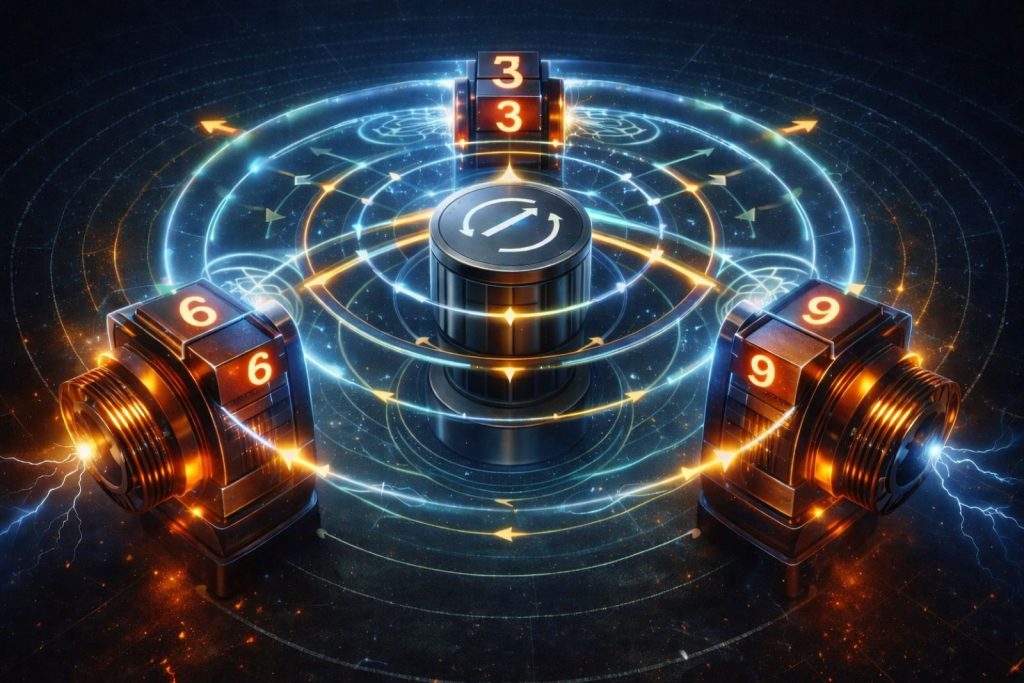
This concept made possible the development of polyphase electric motors. In such motors, the magnetic field rotates and drives the rotor without mechanical contact. This principle allowed electric motors to become simpler, more efficient, and more reliable. Today it is used in countless industrial systems and household devices. Buck emphasizes that this concept was above all an achievement of extraordinary imagination.
Tesla often explained that he could visualize his inventions clearly in his mind before building them. This ability of mental visualization was one of his greatest strengths. Many engineers rely on trial and error in laboratories. Tesla frequently solved problems mentally before constructing anything physically.
Buck’s words illustrate how exceptional Tesla’s method of thinking truly was. His creativity allowed him to conceive entirely new technological solutions. The quote reminds us that major inventions begin as ideas within the human mind. Tesla possessed a rare ability to transform such ideas into reality.
A Mind That Saw Further
“I can find no mistakes in Tesla’s thoughts.” — Charles Proteus Steinmetz
Charles Proteus Steinmetz was one of the most influential electrical engineers and mathematicians of his era. His work on the mathematical analysis of electrical systems played a crucial role in the development of electrical engineering. As a scientist who deeply understood the theoretical foundations of electricity, Steinmetz was known for his precise and critical evaluation of scientific ideas.
For that reason, his statement about Tesla carries exceptional weight. When Steinmetz says that he cannot find mistakes in Tesla’s thinking, he is acknowledging the intellectual strength of Tesla’s concepts. Tesla’s ideas often appeared unusual and sometimes even controversial. Nevertheless, many of them later proved remarkably accurate and practical. Steinmetz recognized that these ideas were grounded in a deep understanding of physical principles.
Tesla approached electrical systems with an extraordinary level of intuition. His ability to visualize electromagnetic phenomena allowed him to develop concepts that were later confirmed in practice. Steinmetz’s remark acknowledges the logical consistency and strength of Tesla’s thinking. Recognition from a scientist of such stature reveals much about Tesla’s intellectual power. The quote reminds us that great ideas are often best recognized by those capable of understanding them. Tesla was one of the rare minds able to perceive the structure of the electrical world in a completely new way. Steinmetz recognized and respected that remarkable ability.
Inspiration for Generations of Inventors
“If I could be any other man, I would be Nikola Tesla.” — Lee de Forest
Lee de Forest was an American inventor and one of the pioneers of radio technology. His development of the vacuum tube played a significant role in the early evolution of radio and electronic communication. As an inventor who himself left a lasting mark on technological history, de Forest understood how difficult it is to create truly revolutionary innovations. For that reason, his admiration for Tesla carries special meaning.
When one great inventor expresses the wish to be another, it reveals the depth of Tesla’s influence on his contemporaries. For many engineers, Tesla represented a symbol of creative freedom and scientific courage. His experiments with high voltages and wireless transmission of energy seemed almost unbelievable to observers of his time. Tesla often pursued ideas that others considered too ambitious.
That willingness to think beyond the limits of existing technology made him unique. In this quote, de Forest acknowledges Tesla as an inspiration for many innovators. Such role models encourage new generations to explore the unknown. Tesla demonstrated that science can be both creative and visionary.
His work was not only technical but also inspirational. Many inventors later developed ideas that grew from Tesla’s experiments. The quote shows that Tesla influenced not only technology but also the mindset of future scientists. His example encouraged others to think more boldly and freely. For that reason, Tesla remains a lasting inspiration in the history of innovation.