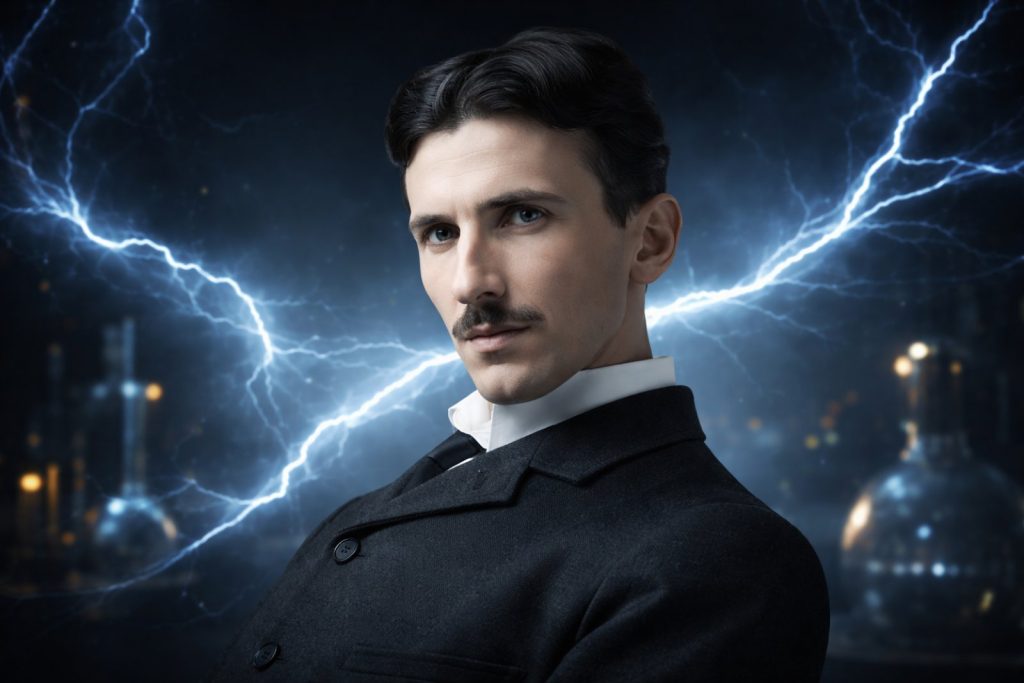
The New World That Must Be Born
“Out of this war a new world must be born. A world in which there will be no exploitation of the weak by the strong, of the good by the evil; in which there will be no humiliation of the poor by the violence of the rich. The works of the mind, of science, and of skill should serve the community to ease and beautify life, not individuals for the acquisition of wealth. That new world cannot be a world of the humiliated and trampled, but a world of free people and nations, equal in dignity and in respect for the human being.”
This quote is powerful because it clearly asks what progress is actually for, and who truly benefits from it. Tesla is not speaking only about technology, but about a social order in which technique and knowledge can be instruments of liberation or instruments of domination. He emphasizes that the weak are often exploited not only through physical force, but through systems, rules, and an economy in which the stronger always hold the advantage.
When he says the poor are humiliated by the “violence of the rich,” it can also be read as a critique of power that hides behind institutions, reputation, and money. The line that the works of the mind and science should serve the community is especially important because it dismantles the idea that innovation is sufficient on its own. Tesla reminds us that an invention has no moral direction until society assigns it one.
Today we are technologically far ahead of Tesla’s era, but the core problem has not changed: who owns technology and who controls its benefits. In a world of automation and artificial intelligence, that issue is even more visible, because productivity rises while profits often concentrate in a small number of hands. Tesla would likely ask: if machines do more work, why don’t people live more easily. The quote also stresses human dignity and respect, a deeper value than a mere “standard of living.”
Material progress without dignity creates a modern form of humiliation: people may have things, but lack security, meaning, and equality. The “new world” in the quote is not just a political project, but a moral yardstick: free people and nations equal in dignity. This is not a sentimental message, but a very concrete test for every idea, reform, or innovation. When we introduce a new technology, we should ask whether it increases freedom or creates dependence.
When we introduce new economic models, we should ask whether they reduce humiliation or merely repackage it in a more sophisticated form. Tesla is essentially demanding that civilization grow up: that knowledge not become a tool of greed, but a tool of humanity. In practice, this is a call for responsibility from both individuals and systems: science without ethics can be brilliant, but destructive. Ethics without knowledge can be well-intentioned, but powerless. Tesla connects the two, which is why the quote still functions both as a warning and as a direction.
Death Does Not Exist
“Death does not exist. And with that knowledge, fear disappears. Remember: no human being who ever existed has died. They have turned into light, and as such they still exist. The secret is that the particles of light return to their original essential state, returning to some prior energy. Christ and some others knew that secret. I searched for how human energy could be preserved. It is one form of light within the soul, sometimes equal to the highest heavenly light. I did not search for this for my own sake, but for the sake of good. I believe my discoveries will make people’s lives easier and more bearable and will guide them toward spirituality and morality.”
This quote speaks to the deepest human fear and tries to transform it into peace. Tesla offers the idea that what we call “death” is not disappearance, but a change of state, a transformation from one form of existence into another. The central message is that fear vanishes when a person stops believing that everything ends in annihilation.
The language of light can be read both literally and symbolically: as a metaphor for consciousness, as a metaphor for energy, as a metaphor for the trace we leave behind. “They have turned into light” sounds like a claim that people are more than a body, that something outlasts matter. The emphasis is on continuity: nothing is lost, it only changes form. Tesla suggests that life has a deeper meaning than biological duration. When he mentions “returning to the original essential state,” he introduces the notion of returning to the source, of cycles, of energy as the fundamental reality.
He moves toward a philosophy in which everything belongs to a larger order, and a human being is one phase within that order. It is also telling that he says he did not search “for himself, but for good.” He shifts away from personal comfort and toward an ethical intention: insight into life and death should serve the purpose of making people better. The quote carries the idea that spirituality and morality are not opposites of science, but that knowledge should lead to inner maturity.
In an era of material abundance and psychological exhaustion, this reads as a call not to lose one’s inner axis. Many people have information, but no peace. Tesla suggests that peace comes from a truth a person accepts, not from external circumstances. When he says his discoveries will ease life, he links progress with a more humane everyday existence. That is an important bridge: technology without morality does not bring calm, and morality without easing life often remains a mere wish.
Tesla seems to want progress to be a means of freeing people from fear, not trapping them in new fears. In today’s world, fear is often produced and sold through media, markets, and politics. This quote goes the other way: liberation from fear as a condition for dignity. In practice, the message is that a person should live so that the “light” within is stronger than panic and instinct. Even if read symbolically, the lesson remains strong: what we are is not only what we possess, but what we become.
Alpha Waves in the Human Brain
“Alpha waves in the human brain are between six and eight hertz. The wave frequency of the human cavity resonates between six and eight hertz. All biological systems operate within the same frequency range. The alpha waves of the human brain function in this range, and electrical resonance is between six and eight hertz. Therefore, our entire biological system—the brain and the Earth itself—operate at the same frequencies. If we can control that resonance system, we can directly control the entire mental state of humankind.”
This quote tries to explain the human being through the ideas of frequency, resonance, and alignment. Tesla speaks as if the brain, the body, and nature are connected by shared rhythms, as if there is a “music” of reality that we all play within. The concept of resonance is powerful because it suggests that small inputs can create large effects when the right frequency is reached. In human experience we often see this through emotions, focus, and collective mood: there are moments when society “locks onto” an impulse and moves in a particular direction.
The quote implies that a human being is both biological and energetic, with inner rhythms that can be harmonized or disturbed. That opens an important topic: mental state is not only personal, but also shaped by environment, daily rhythm, stress, information, and stimuli. When it says that “the brain and Earth operate at the same frequencies,” the message can be understood as a reminder that we are not separate from nature, but part of a wider system. In the modern world we live increasingly against natural rhythms: less sleep, more screens, more noise, less silence.
That mismatch is often paid for with anxiety and loss of focus. Tesla then goes further and speaks about the possibility of controlling “the mental state of humankind.” Even without a technical reading, that line strikes a contemporary nerve: mass psychology can be steered. Today this happens through media, algorithms, propaganda, economic insecurity, and a culture of constant comparison. The quote becomes a warning that collective consciousness is not neutral, but susceptible to influence. In that sense, “resonance” can be read as a metaphor for information waves: trends, viral content, narratives that spread.
Tesla’s point is that whoever understands the principles of influence can shape the behavior of crowds. That is dangerous power, but also responsibility. We now live in a world where attention competes on a market, and mental health becomes collateral damage. The quote suggests that humankind must develop resilience: the ability not to resonate with everything it is fed. It also pushes personal discipline: if you can “tune” yourself, you can preserve calm and clarity. The question it raises is simple: who is tuning you. If the answer is not “you,” then someone else is doing it for you. Tesla points to mental sovereignty, making the quote relevant as a call to awareness, attention hygiene, and protection of inner freedom.
A Poem by Nikola Tesla
“Through a cosmic earpiece I listen to what the stars are saying. They have brought someone new and are showing him Olympus. Over there is Archimedes, always walking with his lever; he says that matter is the same as energy, and that your rigid laws are empty nonsense.”
This passage shows Tesla in a poetic mode, as a man who sees the scientific world as symbolic, almost mythical space. The “cosmic earpiece” immediately creates the image that the universe communicates, that nature speaks, and that the human being must learn to listen. The stars “speak” as if they carry knowledge beyond human conflicts and short-sightedness. Bringing in Olympus blends science and mythology, as if Tesla is saying that the greatest ideas live in a realm that is both rational and archetypal.
Archimedes with his lever symbolizes a foundational truth of physics: with the right fulcrum and the right principle, a small force can move a great weight. That is also a metaphor for innovation: you do not always need more power, you need a better principle. The line “matter is the same as energy” introduces a modern intuition that reality is deeper than it appears, that what we experience as “solid” has its own hidden dynamics and transformations.
The poem then mocks the “rigidity” of laws—not in the sense that the laws of nature do not hold, but in the sense that human certainty in its own frameworks often becomes a limitation. People like rules because they offer a feeling of control, but that feeling can kill creativity. Tesla suggests that major breakthroughs happen when someone has the courage to think beyond what is already established.
That does not mean rejecting science, but deepening it. This is especially relevant today because we live in an age of specialization: everyone knows “their piece,” but few have breadth. The passage reminds us that science is not only calculation, but also a way of seeing the world. It also implies that genius is not born from cynicism, but from curiosity and inner vitality. Stars, Olympus, and Archimedes are not an escape from reality, but a way of seeing reality as larger and richer.
In a society where everything is measured by utility and speed, this kind of text restores a sense of wonder. And without wonder, there is no discovery. The message to the reader is to cultivate the ability to listen: to nature, to ideas, to the part of yourself that is not satisfied with superficial answers. Tesla’s underlying claim is that the human spirit must not be reduced to bureaucratic reason alone. There must remain room for vision. That combination—strict logic and free imagination—is precisely what made Tesla exceptional.
If I Am Lucky
“If I am fortunate enough to realize at least some of my ideas, it will be a benefaction to all humankind. If those hopes are fulfilled, my sweetest thought will be that it is the work of a Serb.”
This quote holds together two things that are not often kept together: universal responsibility and personal identity. Tesla first stresses that the value of his ideas is not in fame, but in benefit for all people. That is the core difference between invention as an ego project and invention as service. When he says “a benefaction to all humankind,” he raises the bar: it is not enough to be clever, one must be useful in the best sense of the word.
The second sentence adds a human dimension: pride in origin. That is not necessarily the opposite of universalism; it is the emotional truth that a person belongs to a language, a culture, and a people. Tesla suggests that great ideas are not born in a vacuum, but out of real life and real roots. Today we are often pushed to believe that success is purely individual, but Tesla reminds us that a person is shaped by what they have received: family, education, tradition, place.
The phrase “if I am lucky” is also significant. Genius without luck, without circumstances, without timing, often never reaches full expression. Tesla recognizes that even the best ideas need the opportunity to become reality. In today’s world, that reads as a reminder that success is not only work, but context: the market, the era, support, infrastructure. Yet Tesla does not stop there; he returns to meaning: if the ideas become real, the gain is for everyone. In relation to our time, it is a critique of a culture in which innovation is often measured by valuation rather than by real improvement of life.
Tesla would likely ask whether we have become smarter or merely more profitable. Practically, the quote is guidance for anyone who creates: work so that your result has value beyond your personal gain. If money is the only criterion, it is too small. Another important message is that you do not need to be ashamed of identity as long as you do not forget the humanity of others. Pride can be healthy if it does not turn into exclusivity. Tesla is both “from somewhere” and “for everyone” at the same time. That balance is rare. And that is why the quote remains a strong reminder that greatness is not rising above people, but working for people.
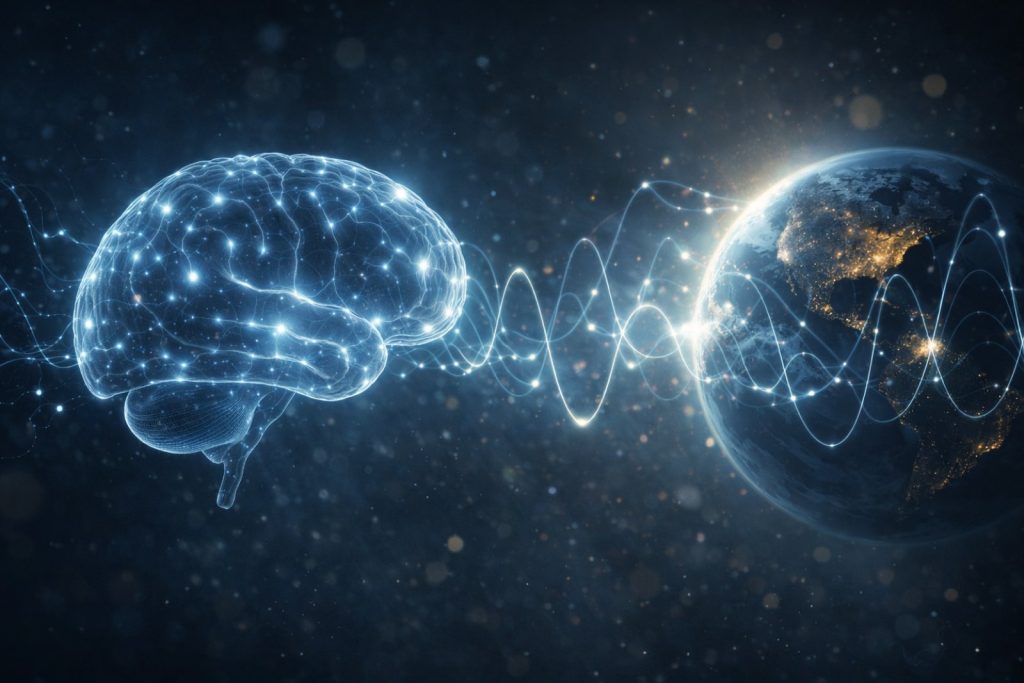
The Gift of Mental Power and Energy
“The gift of mental power and energy comes from God, the supreme being. If we focus our thoughts on that truth, we come into harmony with that great power.”
This quote speaks about the source of strength, but even more about how strength is activated. The first sentence sets the idea that mental power is not only a product of muscles, chance, or schooling, but has a deeper foundation. Regardless of how one understands the word “God,” the key point is that Tesla speaks of a higher principle that rises above the ego. That can be a spiritual truth, but it can also be a symbolic way of saying: there is order, law, and meaning that do not depend on our moods. The second sentence is more practical: the focusing of thoughts.
Tesla is saying that mental energy does not grow out of scattered attention, but out of concentration. In today’s world this sounds almost like therapy for modern chaos: too much information, too little depth. When thoughts are constantly fragmented, a person feels exhausted and weak, even when they objectively have everything they need. Tesla emphasizes harmony with “great power,” which can be understood as alignment with truth, purpose, and highest values. In practice, that means stopping reactive living and starting intentional living.
Many people today live by other people’s priorities: algorithms decide what they watch, markets decide what they desire, environments decide what they “must” do. This quote returns attention to inner leadership: you choose where your attention goes. And attention is the fuel of mental power. Tesla would likely say that the greatest luxury is the ability to do deep work and deep thinking. When you direct your mind, you gain not only productivity but peace, because the brain stops jumping between a thousand threats and desires. “Coming into harmony” means no longer being at war with yourself.
In that state a person becomes steadier, clearer, and more resilient. Compared to Tesla’s era, we now have far more external stimulation, so focusing the mind is harder, but also more important. The quote becomes a call for mental discipline: filter, simplify, choose what is sacred to you, and stop negotiating with it every day. When a person has that inner axis, energy is not wasted on trivialities. Tesla’s message is that strength is not only in intelligence, but in direction. And that real power begins when the mind stops scattering and starts serving something greater than the next impulse.