
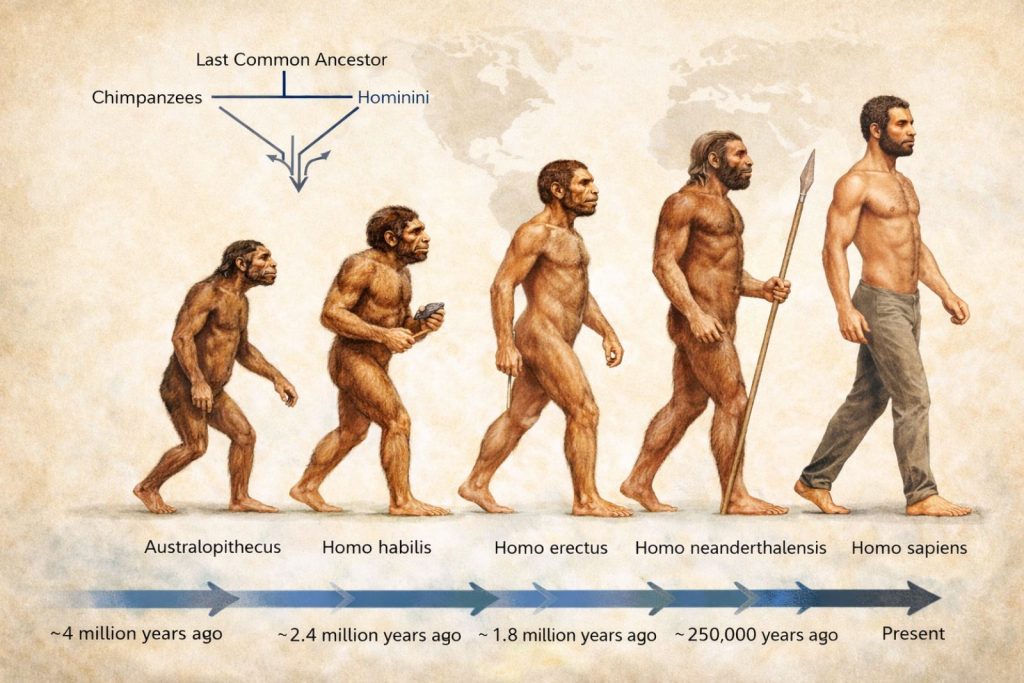
The history of humankind represents a long process of biological and cultural evolution that began millions of years ago in Africa. It encompasses the development from primates to modern humans, Homo sapiens, through phases of adaptation, upright walking, tool use, brain development, and cultural growth. This process ultimately led to the formation of complex societies as we know them today.
Key Aspects of Human History
Human origins and evolution span millions of years. During this period, various species of the genus Homo developed, such as Homo habilis and Homo erectus, characterized by larger brains and more advanced tool use. Homo habilis, who lived approximately 2.4 to 1.5 million years ago, was among the first to use stone tools. Homo erectus appeared roughly between 200,000 and 30,000 years ago in Europe and Asia, developing a distinct culture. Homo sapiens, anatomically modern humans, emerged around 200,000 years ago and continue to exist today.
In addition to biological changes, human development has been marked by the growth of culture, language, art, agriculture, and technology. These developments enabled adaptation to diverse living conditions and the transition from small hunter-gatherer groups to a global civilization.
Human Evolution as a Scientific Field
Human evolution is a multidisciplinary field of scientific research that seeks to explain the origin and development of the human species. It includes disciplines such as anthropology, genetics, archaeology, and biology. In this context, the term human primarily refers to Homo sapiens, although research also includes ancestral species from the hominid family, such as Australopithecus.
What Is Human Anthropology
Anthropology is a holistic science of the human species that studies the biological, cultural, and social diversity of people from prehistory to the present. It explores evolution, behavior, languages, customs, and beliefs, seeking to answer the fundamental question of what it means to be human and how different societies have developed.

Key Areas of Anthropology
Physical or biological anthropology focuses on human biological evolution, genetics, and adaptation to different environments. Socio-cultural anthropology examines social relations, cultures, customs, and beliefs worldwide. Archaeology studies past human cultures through material remains, while linguistic anthropology analyzes the influence of language on social life and culture. Anthropology views humans as a whole, connecting biological, social, and cultural dimensions.
History of Anthropology
The term anthropology derives from the Greek words anthropos (human) and logos (science or study). As a scientific discipline, it began developing in the late 16th century and expanded significantly during the 19th century. Among the early theorists were Thomas and Caspar Bartholin, who defined anthropology as a science studying humans through anatomy and psychology. During the 19th century, ethnological societies were established in Paris, New York, and London. Anthropologists of that period were often advocates of human rights and opponents of slavery. In the early 20th century, a major paradigm shift occurred, leading to the abandonment of strict evolutionary approaches. Franz Boas, an American anthropologist, is considered the founder of cultural anthropology and a proponent of cultural relativism.

Cultural Relativism and Modern Anthropology
Cultural relativism emphasizes that differences between cultures are not based on biological differences or race, but on historical and social circumstances. This approach has had a significant influence on modern anthropology, particularly in opposing racial ideologies and promoting multicultural understanding.
Fields of Anthropological Study
Anthropology examines economics, politics, religion, kinship systems, diet, customs, and cultural practices across the world, from traditional communities to contemporary societies. As an interdisciplinary field, it integrates knowledge from the humanities and social sciences.
Historical and Institutional Context
Anthropology developed alongside the Enlightenment and the emergence of modern social sciences. Contemporary anthropologists often note that increasing global interconnectedness brings both cultural convergence and new social divisions. The discipline seeks to understand these processes from both historical and contemporary perspectives.
Types of Anthropology
Paleoanthropology studies human origins through fossils and reconstructions of early human life. Bioanthropology analyzes human biological diversity and the relationship between biology and culture. Prehistoric anthropology investigates ancient societies through archaeological remains, while ethnology compares cultures and societies worldwide.
Anthropology as a Discipline
Anthropology studies human life, culture, similarities and differences among people, and how humans relate to their environment. It focuses on the past, present, and future of the human species. At its core, its central question remains: what does it mean to be human?