
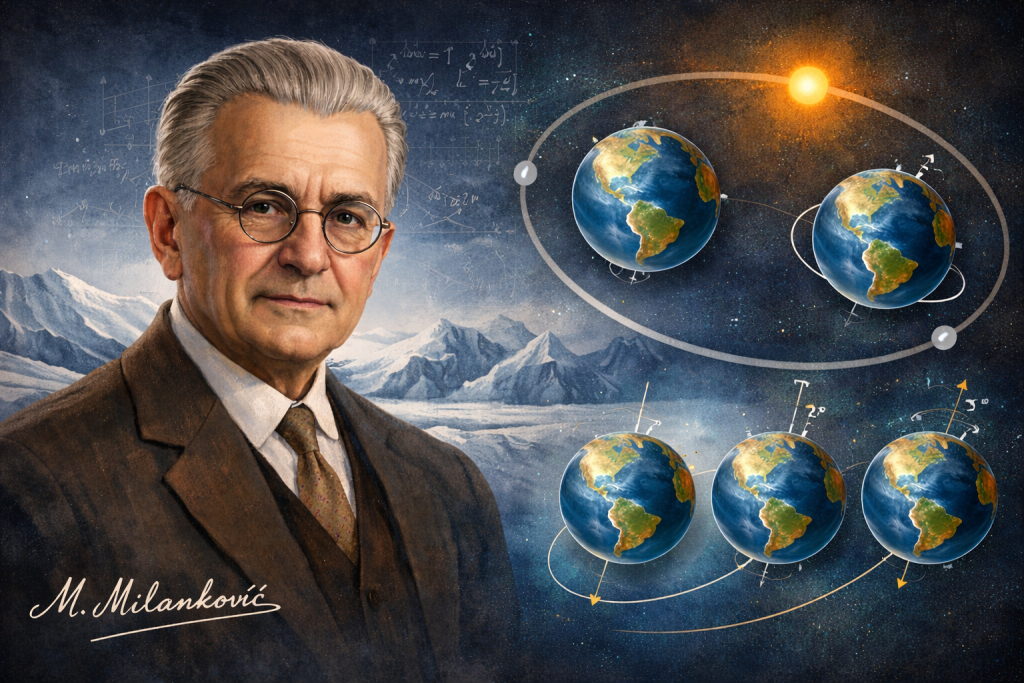
Milutin Milanković was a Serbian scientist who was the first to mathematically and precisely explain how changes in Earth’s orbit and the tilt of its axis influence long-term climate change. His theory, today known as Milanković cycles, explains the alternation of ice ages and warm periods in Earth’s geological past and represents a foundation of modern paleoclimatology.
Milanković demonstrated that Earth’s climate is neither static nor random, but deeply connected to precise and slow changes in our planet’s motion through space.
Key Milanković cycles
Milanković’s theory is based on three fundamental orbital processes that affect the distribution of solar energy on Earth.
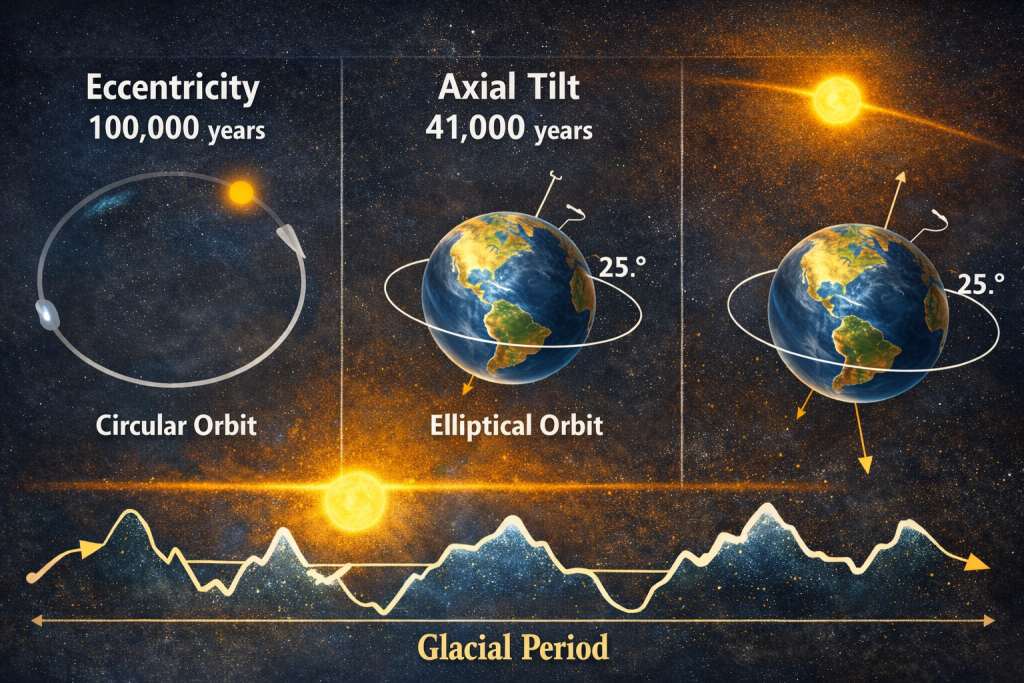
Eccentricity refers to changes in the shape of Earth’s orbit around the Sun. This orbit is never a perfect circle but an ellipse whose shape changes very slowly. The cycle of shifting from a nearly circular orbit to a more elongated ellipse and back lasts approximately 100 000 years.
The tilt of Earth’s rotational axis is also not constant. It oscillates between approximately 22 and 24.5 degrees. These changes affect the intensity of the seasons, especially the amount of solar energy received at high latitudes. The cycle of axial tilt changes lasts about 40 000 years.
Precession is the third process and refers to the slow wobble of Earth’s rotational axis, similar to the motion of a spinning top as it slows down. This cycle lasts about 26 000 years and affects the timing of the seasons within Earth’s orbit.
The significance of Milanković’s work
Milanković showed how these orbital cycles change both the amount and the spatial distribution of solar energy reaching Earth’s surface. Although these changes are small on an annual scale, over long periods they lead to regular and cyclical alternations of cold and warm climatic phases.
His theory unified astronomy, mathematics, and geophysics into a single model explaining long-term climate change. Although Milanković cycles are natural processes, modern science clearly distinguishes these slow variations from today’s much faster climate changes, which are predominantly caused by human activity.
The scientific triumph of Milutin Milanković
Milanković entered the annals of world science not only because he explained why Earth warms and cools, but also because he did so decades before his predictions could be confirmed by measurements. He was one of the rare scientists who theoretically predicted natural processes without direct empirical data, only to later be proven correct.
Today, his name is borne by Milanković cycles, a prestigious European Union geosciences medal, craters on the Moon and Mars, an asteroid, as well as a park and a boulevard in Belgrade, the city where he spent most of his life. His work clearly reveals the complexity of Earth’s climate system and represents one of the greatest theoretical achievements in the history of climatology.
The link between Earth’s motion and its climate
In his work, Milanković sought to explain how slow but regular and cyclical changes in Earth’s motion around the Sun produce equally slow yet profound changes in climate. Over tens and hundreds of thousands of years, these changes can lead to the onset of ice ages.
Changes in orbital shape affect the total amount of solar energy Earth receives during the year. Changes in axial tilt influence how that energy is distributed between the equator and the poles, while precession determines where in the orbit the seasons occur.
The distribution of solar energy and ice ages
During its motion around the Sun, Earth receives approximately the same total amount of energy, but the way this energy is distributed across hemispheres and seasons plays a decisive role. Milanković’s key assumption was that reduced summer insolation at high northern latitudes allows snow and ice to persist from year to year, gradually leading to the development of ice ages.
Later research confirmed this assumption. Changes in Earth’s motion do indeed drive cycles of cooling and warming, which is why these processes are collectively known today as Milanković cycles.
Ice ages and feedback mechanisms in the climate system
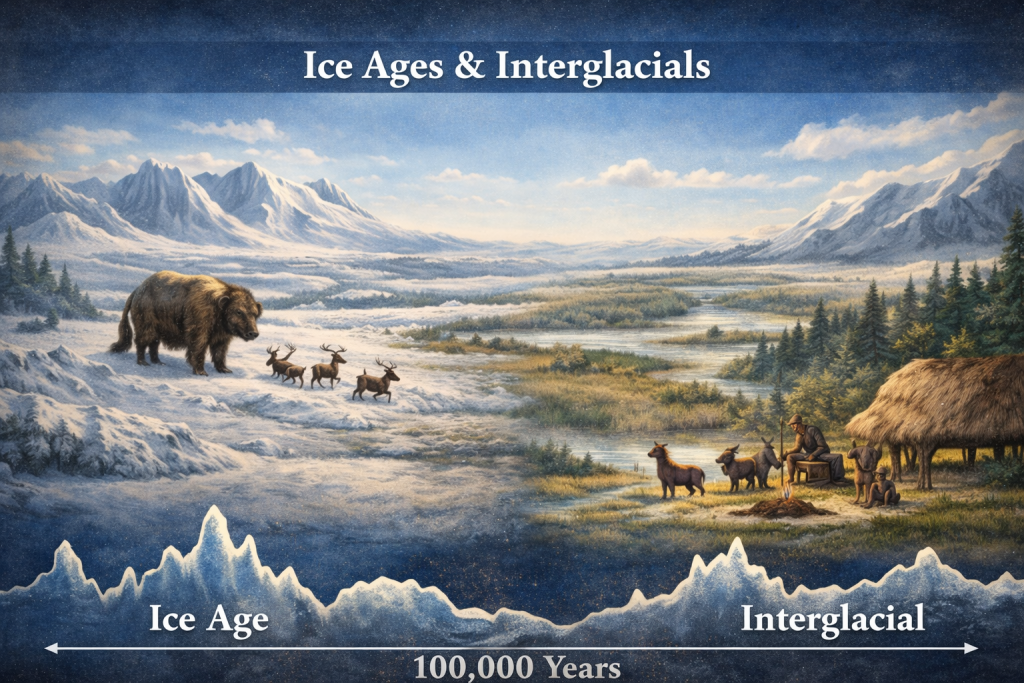
During ice ages, Earth’s surface changes dramatically. Global average temperatures drop by several degrees, ice sheets expand toward temperate latitudes, and global sea levels fall by up to one hundred meters. This is followed by a period of warming, and then a new phase of gradual cooling.
Milanković cycles do not act alone. They trigger a whole series of feedback mechanisms within Earth’s climate system. One of the most important is the albedo effect: snow and ice reflect a large portion of incoming solar radiation, which further cools the surface and slows melting.
Why cold summers are crucial
Milanković emphasized that ice ages do not begin because of cold winters, but because of cold summers. When summers are cool, the snow and ice accumulated during winter do not fully melt. Bright surfaces near the poles then reflect even more solar energy, further amplifying the cooling process.
Alongside the albedo effect, carbon dioxide also plays an important role. As the oceans cool, they absorb larger amounts of this gas from the atmosphere, weakening the greenhouse effect and further lowering global temperatures.
The cyclical history of Earth’s climate
Through the combined action of orbital changes, the albedo effect, and variations in carbon dioxide concentration, regular cyclical alternations of cold and warm periods arise in Earth’s history. The value of Milanković’s work lies in the fact that he predicted these processes long before precise data on the duration and rhythm of ice ages existed.
His theory was not immediately accepted, as orbital changes were long considered too weak to produce such dramatic climatic effects. Only in the second half of the twentieth century, with the development of deep ice-core and ocean-sediment records, did Milanković’s predictions receive firm empirical confirmation*.
* Empirical confirmation in this context refers to the later verification and validation of Milanković’s theoretical predictions using real, independent data that were not available to science at the time the theory was developed. With the advancement of modern paleoclimatology in the second half of the twentieth century, analyses of ice cores, deep-sea sediments, and isotopic records demonstrated that the timing of cold and warm periods in Earth’s geological past corresponds closely with the periods of Milanković’s orbital cycles. This showed that a theory developed purely through mathematical and astronomical reasoning accurately describes the real behavior of Earth’s climate system.