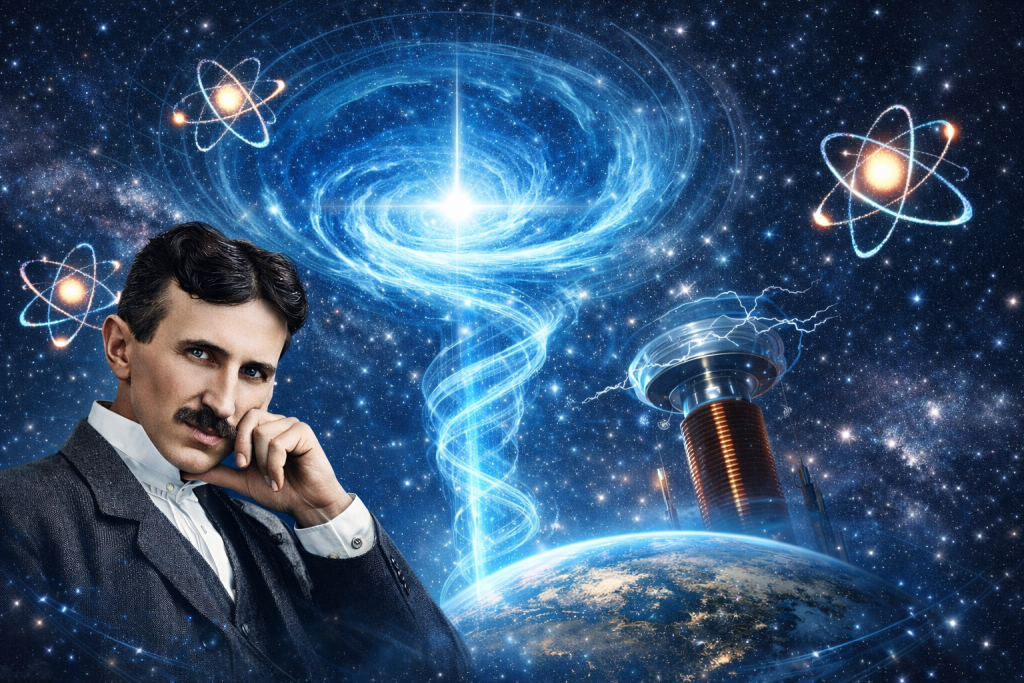
Zero-point energy can be viewed as both the origin and destination – the alpha and omega of all waves of creation. All material reality emerges from this foundational “reservoir” of energy. Ether theorist Winger (one among many) states that universal consciousness is what focuses waves into the zero point and sustains its rotation, its vortex, which drives the dynamics of existence.
This can be compared to the action of geometric force within the ether: each individual node of electromagnetic waves behaves like a fragment of consciousness. In the human body, this focus manifests as personal, individual awareness, which is part of a larger, cosmic consciousness. According to this interpretation, Nikola Tesla recognized this connection through his work and insights.
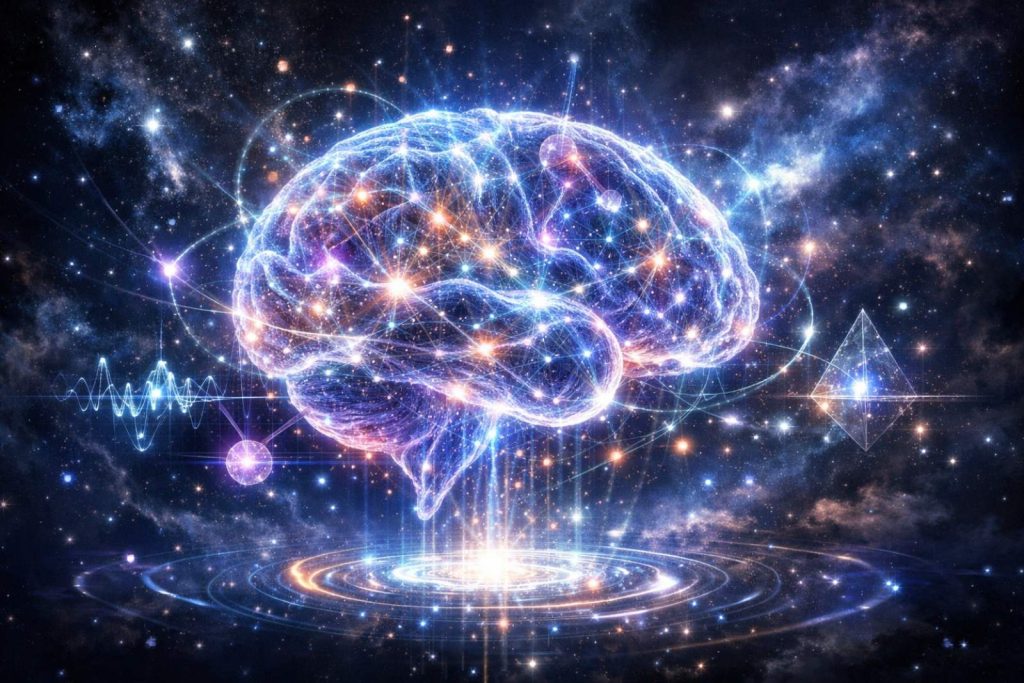
In that context, the brain is not merely a biological organ, but an antenna receiving information from a universal field. Comparable ideas appear in modern theories of the “quantum brain.” If this premise holds, every mind could theoretically access a universal mind; the difference lies only in the degree of development and the amount of awareness an individual can perceive.
Free Energy and the Zero Point
One of the most controversial aspects of Tesla’s legacy is the concept of “free energy” – the idea that energy could be drawn directly from space, without cost, combustion, or conventional fuel. Tesla believed it was possible to tap into the energy generated by the electromagnetic fields of Earth and the cosmos.
Some experts argue that these attempts were more philosophical than scientific, relying on assumptions that still lack measurable confirmation. However, models such as the quantum zero-point field suggest that a form of omnipresent energy may indeed exist, although it remains technologically unreachable today.
Tesla’s work brings us closer to the possibility that such an energy source could be real. Still, in practical terms, there is currently no functional technology to prove it, nor a scientific consensus to verify its feasibility.